
What is retatrutide? In short, it is an investigational medicine developed by Eli Lilly that activates three hormone receptors involved in appetite and metabolism: GIP, GLP-1, and glucagon. It is currently in Phase 3 clinical trials for obesity and type 2 diabetes and has not been approved by regulators such as the FDA or Health Canada.
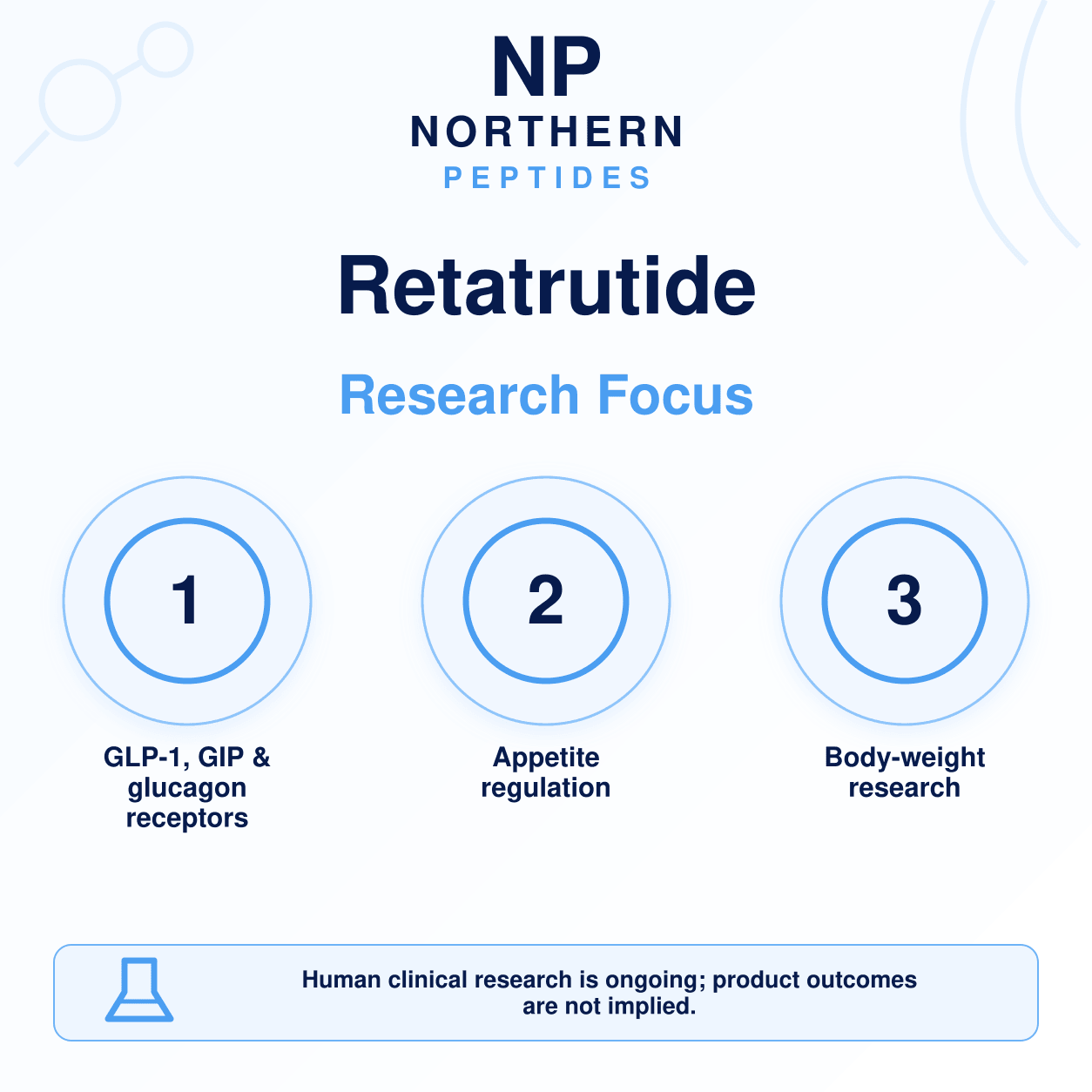
What Is Retatrutide? A Quick Overview
For readers who want the essentials before diving in, here are the key facts that answer the question “what is retatrutide” as of October 2026:
- Developer: Eli Lilly and Company
- Laboratory code: LY3437943
- Drug class: triple hormone-receptor agonist, targeting GIP, GLP-1, and glucagon receptors
- How it was given in trials: once-weekly subcutaneous injection
- Being studied for: chronic weight management in people with obesity or overweight, and glycemic control in people with type 2 diabetes
- Development stage: Phase 3 clinical trials underway
- Regulatory status: not approved by the FDA, the European Medicines Agency, or Health Canada
Taken together, these facts give a working definition of what is retatrutide today: an investigational triple agonist with striking mid-stage results and no regulatory approval yet.
The rest of this article explains what those facts mean: where retatrutide came from, how it is designed to work, what the clinical trials have found so far, and what questions remain unanswered.
Where Did Retatrutide Come From?
The question “what is retatrutide” has a history behind it: the molecule did not appear out of nowhere. It is the latest chapter in a scientific story that began more than half a century ago with the discovery of the gut hormones that tell the body food has arrived.
In the early 1970s, researchers isolated a hormone from the gut called GIP (glucose-dependent insulinotropic polypeptide), one of the first of what came to be known as incretin hormones. In the 1980s, a second incretin, GLP-1 (glucagon-like peptide-1), was characterized. These hormones are released by the intestines after eating, and they signal the pancreas to release insulin, slow the rate at which the stomach empties, and communicate fullness to the brain. For years they were interesting physiology; turning them into medicines took decades of protein engineering.
The first incretin-based medicine reached patients in 2005. Exenatide was developed from exendin-4, a peptide first found in the saliva of the Gila monster, a venomous lizard. That unlikely origin produced a drug that mimicked GLP-1 and lowered blood sugar. Longer-acting versions followed, including liraglutide and then semaglutide, which arrived in 2017 and became widely known for both diabetes care and, at higher doses, weight management. Each generation lasted longer in the body and produced larger average weight reductions than the last.
The next conceptual step was to combine hormone signals in a single molecule. In 2022, tirzepatide was approved, activating both the GIP and GLP-1 receptors, and its clinical trials showed greater average weight loss than GLP-1-only medicines had achieved. That result raised an obvious scientific question: if two receptors are better than one, would three be better than two? Retatrutide is Lilly’s answer to that question, adding the glucagon receptor to the GIP/GLP-1 combination — and that three-receptor design is the core of any complete answer to “what is retatrutide.” Early human studies of the compound began in the early 2020s, and the development code LY3437943 that appears in scientific papers is simply Lilly’s internal numbering for the molecule.
Lilly is not the only company exploring multi-receptor designs, but retatrutide is the furthest along in clinical testing among the triple-agonist candidates, which is why it attracts the most attention in the research literature.
What Is Retatrutide? How the Triple Agonist Works
If you are still wondering what is retatrutide after the overview above, the mechanism is the heart of the answer. The phrase “triple agonist” is doing a lot of work in every article about retatrutide, so it is worth unpacking carefully in plain language.
What “agonist” means
In pharmacology, an agonist is a molecule that switches a receptor on. Receptors are protein structures on the surface of cells that respond to chemical signals. When the body’s own hormone docks with its receptor, the receptor fires and the cell responds. An agonist drug is essentially a manufactured key cut to fit that same lock. Retatrutide is designed as a single molecule with activity at three different locks: the receptors for GIP, GLP-1, and glucagon — which is exactly what “what is retatrutide” means in pharmacological terms. It does not contain three separate drugs; one engineered peptide chain is shaped to engage all three receptor types.
The three receptors, in plain English
Each of the three targets plays a distinct role in how the body handles food and energy:
- GIP receptors respond to a gut hormone released after meals. GIP signaling supports insulin release when blood sugar is elevated and appears to influence how the brain processes food-related reward and appetite signals.
- GLP-1 receptors respond to the best-understood of the three hormones. Activating them slows stomach emptying, increases feelings of fullness after eating, reduces appetite through brain signaling pathways, and helps the pancreas release insulin in a glucose-dependent way (meaning mainly when blood sugar is high, which lowers the risk of driving sugar too low).
- Glucagon receptors respond to a hormone made by the pancreas that has the opposite job of insulin in one important respect: it raises blood sugar by telling the liver to release stored glucose. That sounds counterproductive for a diabetes drug, which is exactly why the glucagon component is the most scientifically interesting part of retatrutide. Glucagon also appears to increase energy expenditure and reduce food intake through central nervous system pathways, and researchers believe that adding glucagon activity might help the body burn more energy while the GIP and GLP-1 activity keeps blood sugar and appetite in check.
Why combine all three?
Obesity and type 2 diabetes are not single-pathway disorders. Appetite, insulin sensitivity, fat storage, and energy expenditure are controlled by overlapping hormonal systems, and medicines that pull only one lever have historically produced modest results. The hypothesis behind retatrutide is that engaging three complementary pathways at once could produce larger and more durable metabolic effects than engaging one or two: appetite and food intake pushed down by GIP and GLP-1 signaling, blood sugar controlled through glucose-dependent insulin effects, and energy expenditure nudged upward by glucagon signaling. Whether that hypothesis holds up in large, long-term trials is precisely what the Phase 3 program — the next chapter in the “what is retatrutide” story — is designed to find out.
It is important to keep the word “hypothesis” in mind. Elegant pharmacology does not always translate into better outcomes for patients, and the history of drug development includes many clever multi-target molecules that failed in late-stage testing. The trial data, not the mechanism diagram, is what matters.
The Clinical Trial Landscape
To make sense of retatrutide headlines — and to judge for yourself what is retatrutide beyond the hype — it helps to understand how the evidence is being built, study by study.

A quick primer on trial phases
New medicines are tested in stages. Phase 1 studies are small and focus on safety: how the drug is absorbed, how long it lasts in the body, and what doses people tolerate. Phase 2 studies are larger and ask whether the drug actually works, testing several doses against a placebo over weeks or months. Phase 3 studies are the large, long trials meant to confirm benefits and detect less common side effects in thousands of participants; regulators base approval decisions primarily on Phase 3 data. Retatrutide has completed Phase 1 and Phase 2 testing and is now in Phase 3, and each phase has added detail to the scientific picture of what is retatrutide.
Phase 2 in obesity: published in the New England Journal of Medicine (2023)
The study that put retatrutide on the map enrolled 338 adults with obesity (or overweight plus a weight-related health condition) and randomized them to various weekly doses of retatrutide or placebo for 48 weeks. The results, published in the New England Journal of Medicine in mid-2023, were striking by the standards of obesity medicine: participants receiving the highest dose (12 mg weekly) lost an average of 24.2 percent of their body weight, compared with about 2 percent in the placebo group.
Lower doses produced smaller but still substantial average losses, showing a clear dose-response relationship. A large share of participants on the higher doses lost at least 15 to 20 percent of their starting weight, thresholds that are considered clinically meaningful because weight loss of that magnitude is associated with improvements in blood pressure, blood sugar, and other risk factors.
Context matters here. Average weight loss of more than 20 percent had previously been seen mainly with bariatric surgery, not with medicines. That comparison is what turned “what is retatrutide” from a laboratory code into a headline, but it comes with caveats: the trial was relatively small and lasted less than a year, participants received intensive lifestyle support alongside the drug, and averages conceal wide individual variation.
Phase 2 in type 2 diabetes: published in The Lancet (2023)
A second Phase 2 trial studied 281 adults with type 2 diabetes over 36 weeks, comparing several retatrutide doses against both placebo and dulaglutide, an established GLP-1 medicine. The trial reported clinically meaningful reductions in glycated hemoglobin (HbA1c), the standard marker of average blood sugar: about 2 percentage points at the highest retatrutide dose, which exceeded the reductions seen with both placebo and dulaglutide. The full paper appeared in The Lancet in 2023.
Participants also lost substantial amounts of weight, again more than with either comparator. For a single investigational molecule to move both blood sugar and body weight more than an approved GLP-1 drug was a notable result — and it added a second pillar to the scientific answer to “what is retatrutide” — though the same caveats about trial size and duration apply.
Phase 3: the TRIUMPH program
Retatrutide is now being evaluated in Lilly’s Phase 3 TRIUMPH program, a set of large trials studying the drug in different populations, including people with obesity and people with both obesity and type 2 diabetes. The program includes studies such as TRIUMPH-9, a trial in adults with obesity or overweight whose public record is listed on ClinicalTrials.gov.
In late September 2026, Lilly released detailed results from TRIUMPH-2, a Phase 3 trial in adults with obesity or overweight and type 2 diabetes: participants on the 12 mg dose lost up to 20.8 percent of body weight on average over 80 weeks, with A1C reductions of up to 1.6 percentage points, and results were presented at the EASD 2026 scientific meeting. These are the first large-scale Phase 3 data for a triple-agonist medicine, which makes them a genuine milestone in the “what is retatrutide” timeline.
Two cautions apply: the detailed results were initially communicated through a company announcement rather than a peer-reviewed journal publication, and 80-week data, while longer than the Phase 2 trials, still do not answer questions about effects over many years.
Reading trial announcements critically
A few habits will help any reader evaluate retatrutide news coverage now that “what is retatrutide” has become a frequently searched question. First, distinguish press releases from peer-reviewed papers: company announcements are not independently vetted and sometimes emphasize the most favorable analyses. Second, remember that averages describe groups, not individuals: in every obesity trial, some participants lose far more than the average and some lose little.
Third, note who funded the research: the major retatrutide trials are sponsored by Lilly, which is normal in drug development but means independent replication matters. Finally, watch the endpoints: weight and blood sugar are surrogate outcomes, and regulators and physicians ultimately care most about whether a drug prevents heart attacks, strokes, kidney failure, and other hard outcomes, which requires dedicated long-term trials.
Retatrutide in Research Context
Beyond the trial numbers, retatrutide matters to researchers for what it might teach about human metabolism — and that scientific significance is part of why “what is retatrutide” keeps appearing in research discussions.
Why researchers are paying attention
Obesity affects hundreds of millions of people worldwide, and until recently, medicines could not reliably produce the magnitude of weight loss that meaningfully changes disease trajectories. If a triple agonist can deliver surgical-scale weight loss with an injection, it would reshape treatment guidelines, and the combination of weight and blood sugar effects in a single molecule addresses the two conditions that so often travel together. Researchers are also watching retatrutide as a test case for rational multi-receptor drug design: if it succeeds, it validates a template that could be applied to other hormonal systems. That broader significance is why the question of what is retatrutide interests scientists well beyond the obesity field.
The energy-expenditure hypothesis
Most weight-loss medicines work primarily by reducing energy intake: people eat less. The glucagon component of retatrutide is interesting because animal studies suggest glucagon receptor activation can increase energy expenditure, meaning the body burns more calories at rest. If that effect translates to humans, retatrutide would attack the energy-balance equation from both sides, eating less and burning more — a detail that would enrich any textbook answer to “what is retatrutide.” Whether the weight loss seen in human trials actually involves a meaningful expenditure component, as opposed to appetite suppression alone, remains an open scientific question that specialized metabolic studies are trying to answer.
Open questions
Several important questions cannot yet be answered:
- Long-term safety: the trials so far span months to under two years. Rare or slow-emerging side effects would only appear in longer and larger studies.
- Durability after stopping: studies of related medicines show that weight tends to return after treatment stops; a withdrawal study of tirzepatide found participants regained a substantial portion of lost weight within a year. Whether the same applies to retatrutide is unknown.
- Body composition: rapid weight loss typically includes some loss of lean muscle mass along with fat. How much of retatrutide-associated weight loss is fat versus lean tissue is still being characterized.
- Hard outcomes: dedicated cardiovascular outcomes trials, which follow participants for years to measure heart attacks and strokes, have not yet been completed for retatrutide.
- Real-world use: clinical trial participants receive close monitoring and support that everyday patients may not, so real-world effectiveness and tolerability could differ.
Safety Signals From the Trials So Far

Across the published retatrutide trials — the same studies that define what is retatrutide for clinicians today — the side-effect pattern resembled that of other incretin-based medicines. The most commonly reported adverse events were gastrointestinal: nausea, vomiting, diarrhea, and constipation, typically mild to moderate and most frequent during the dose-escalation period, when participants were working up to their target dose. Small increases in resting heart rate were also observed, a known class effect of GLP-1-based therapies that physicians monitor. Serious adverse events occurred in both the retatrutide and comparator groups.
The essential caveat is that the safety profile of an investigational drug is, by definition, incomplete. Anyone asking what is retatrutide should keep that incompleteness front and center: the trials completed so far were not large enough or long enough to rule out uncommon risks, and the full picture will only emerge from the Phase 3 program and post-approval surveillance if the drug is eventually authorized.
Regulatory Status
As of October 2026, the regulatory answer to “what is retatrutide” is straightforward: it has not been approved by any major medicines regulator. It is not approved by the U.S. Food and Drug Administration, not authorized by Health Canada, and not approved by the European Medicines Agency. Approval would require completion of the Phase 3 program, submission of the data to regulators, and a formal review process that typically takes a year or more after submission. There is no confirmed timeline, and late-stage drug development carries no guarantees: many compounds with promising mid-stage data never reach approval.
Health authorities have also warned the public about unauthorized products sold online that claim to contain retatrutide or similar peptides. Because the genuine compound exists only within the regulated clinical-trial and manufacturing system, products marketed to consumers under its name are unapproved and of unknown content and quality. For research materials generally, independent verification matters: our test results page publishes third-party analyses, and our FAQ page answers common questions about research-use products.
Frequently Asked Questions
Short, plain-English answers to the questions people ask most often about retatrutide.
What does “triple agonist” mean?
It means one molecule designed to switch on three different hormone receptors: GIP, GLP-1, and glucagon receptors. Earlier medicines in this family targeted one receptor (such as semaglutide) or two (such as tirzepatide); the triple-receptor design is the defining feature in any explanation of what is retatrutide.
Is retatrutide a peptide?
Yes. Retatrutide is a peptide-based molecule, a short chain of amino acids engineered from incretin hormone sequences — and that peptide nature is a basic part of what is retatrutide. That is also why it is given by injection in clinical trials: peptides are broken down in the digestive tract, so swallowing them as ordinary pills generally does not work.
How is retatrutide given in clinical trials?
In the clinical trials conducted so far, retatrutide has been administered as a once-weekly subcutaneous injection, with doses gradually increased over several weeks to improve tolerability. This describes the research setting only; the drug is not available as a prescribed treatment, which is an important qualifier whenever someone asks what is retatrutide in a medical context.
Is retatrutide the same as Ozempic or Mounjaro?
No. Ozempic is the brand name for semaglutide, which targets only the GLP-1 receptor, and Mounjaro is the brand name for tirzepatide, which targets GIP and GLP-1 receptors. Retatrutide is a different, investigational molecule that adds the glucagon receptor to that combination — the extra receptor being the key distinction in what is retatrutide versus its approved cousins — and unlike those two medicines, it is not approved or available by prescription.
Has retatrutide been approved anywhere?
No. As of October 2026, no regulator in the world, including the FDA, the European Medicines Agency, and Health Canada, has approved retatrutide. It remains an investigational compound available only within clinical trials — a regulatory fact that belongs in every honest answer to what is retatrutide.
What happens when people stop taking medicines like retatrutide?
With related incretin-based medicines, clinical studies have shown that much of the lost weight tends to return after treatment is stopped; in a withdrawal study of tirzepatide, participants regained a substantial share of their weight loss within a year of switching to placebo. Retatrutide-specific data on stopping treatment are limited, but researchers expect obesity to behave as a chronic condition requiring ongoing management, as with blood pressure or cholesterol medicines.
Where can I read the actual research?
The two landmark peer-reviewed papers are the Phase 2 obesity trial published in the New England Journal of Medicine in 2023 and the Phase 2 diabetes trial published in The Lancet in 2023 — both are cited in the Sources section below, and reading them is the best way to go beyond a summary-level answer to what is retatrutide. Ongoing and recruiting studies can be found in public registries such as ClinicalTrials.gov by searching for retatrutide.
When will we know more?
The Phase 3 TRIUMPH program is expected to read out additional results over the coming years, with full peer-reviewed publications to follow the initial company announcements. Regulatory review, if Lilly submits the drug for approval, would add further time after the trial program completes. Realistic expectations for a complete picture of what is retatrutide should be measured in years, not months.
What Is Retatrutide? The Bottom Line
Retatrutide is an investigational triple-agonist medicine that stimulates the GIP, GLP-1, and glucagon receptors, and it has produced some of the largest average weight reductions ever seen with a medicine in mid-stage trials. It is now in large Phase 3 studies that will determine whether those results hold up at scale and what the long-term safety picture looks like. It is not approved by any regulator, it is not available by prescription, and many important questions about durability, body composition, and hard health outcomes remain open. For now, the most accurate short answer to “what is retatrutide” is that it is a promising and closely watched experiment, not a treatment.
To keep learning, explore our educational resources for more research guides, browse the shop for research-use compounds, or contact our team with questions about this guide.
Sources and Further Reading
- Jastreboff AM, et al. Triple-Hormone-Receptor Agonist Retatrutide for Obesity: A Phase 2 Trial. New England Journal of Medicine, 2023.
- Rosenstock J, et al. Retatrutide, a GIP, GLP-1 and glucagon receptor agonist, for people with type 2 diabetes: a randomized, double-blind, placebo and active-controlled, parallel-group, phase 2 trial. The Lancet, 2023.
- Eli Lilly and Company. TRIUMPH-2 Phase 3 detailed results, September 2026 (presented at the EASD annual meeting).
- TRIUMPH-9 retatrutide trial record. ClinicalTrials.gov.
This article is for educational purposes only and is not medical advice. Retatrutide is an investigational compound; talk to a qualified health professional about weight management or diabetes care.