

Every breakthrough in anti-ageing peptide therapy brings new opportunities along with deep ethical questions for health professionals and researchers. This work demands attention not only to scientific progress but also to the core principles of patient safety, transparent consent, and equitable access. With global regulations evolving and more than 80 peptide drugs now approved for medical use, the field faces rising scrutiny around compliance and safety standards that shape how innovations impact real lives.
Table of Contents
- Core Principles Of Peptide Research Ethics
- Key Peptide Types And Research Applications
- Regulatory Compliance Across Global Jurisdictions
- Balancing Risk Mitigation And Patient Safety
- Ethical Dilemmas In Anti-Ageing Therapies
Key Takeaways
| Point | Details |
|---|---|
| Patient Safety is Paramount | Every decision in peptide research must prioritise patient wellbeing, with thorough risk-benefit analyses conducted continuously. |
| Informed Consent and Transparency | Clinical trial participants must receive clear, accessible information about potential risks and the nature of the research. |
| Equitable Access to Therapies | Strategies must be implemented to ensure that peptide therapies are affordable and accessible to diverse populations. |
| Ethics in Anti-Ageing Research | Discussions around access and affordability must occur early in the development of anti-ageing therapies to mitigate health disparities. |
Core Principles of Peptide Research Ethics
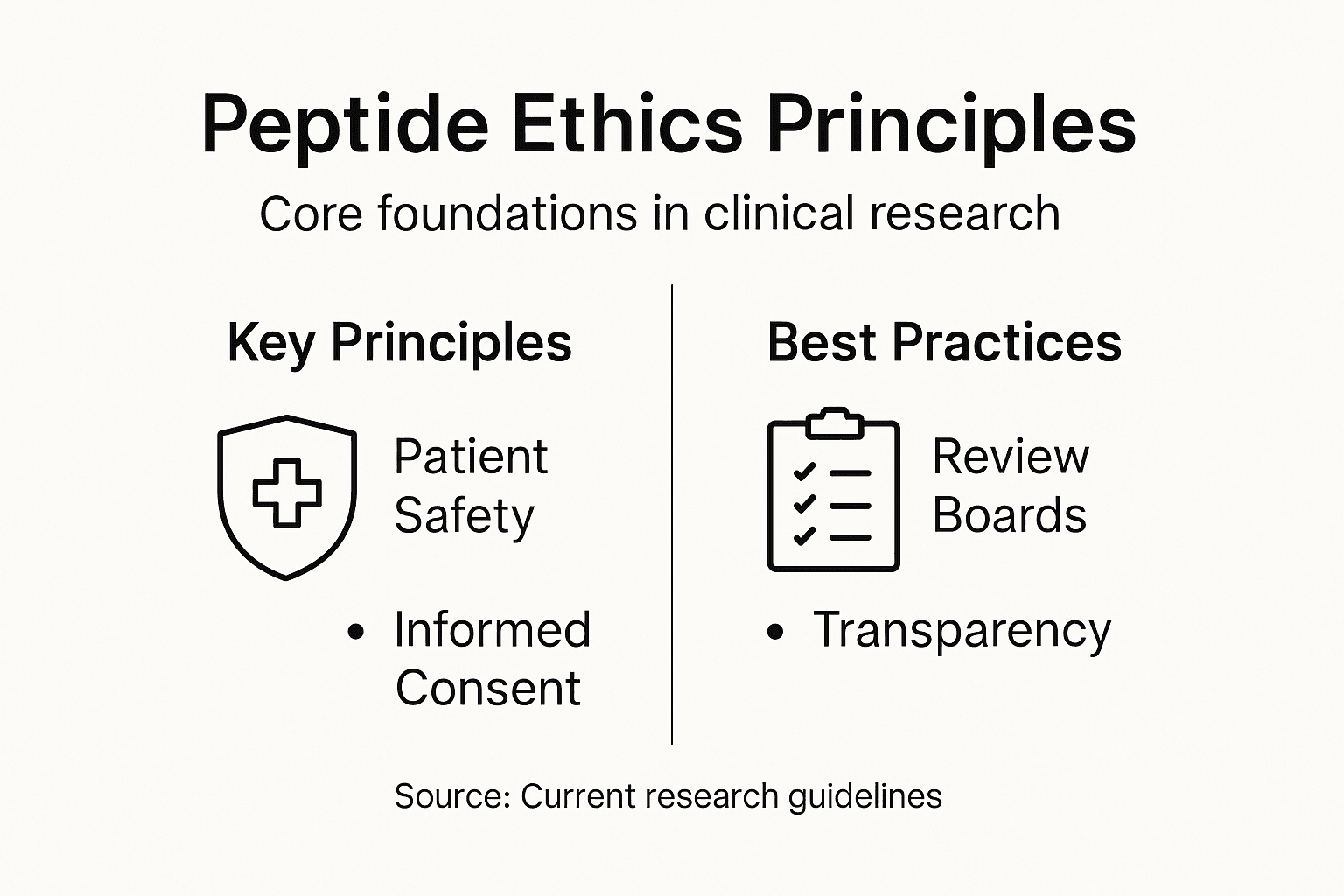
Peptide research sits at a crucial intersection where scientific advancement meets human responsibility. The foundation of ethical peptide research rests on several interconnected principles that guide researchers from initial discovery through clinical application. Patient safety forms the absolute cornerstone of these principles, demanding that every decision throughout the research process prioritises the wellbeing of those who may eventually benefit from or participate in studies. This isn’t merely a regulatory checkbox, it’s a moral commitment that shapes how researchers design experiments, evaluate results, and communicate findings. When developing peptide therapeutics, researchers must conduct thorough risk-benefit analyses that honestly assess potential immunogenic reactions, stability challenges, and other safety concerns specific to peptide compounds. These analyses must be documented transparently and revisited as new data emerges.
Informed consent and transparency represent the second pillar of ethical peptide research. Participants in clinical trials involving peptide therapies deserve complete, understandable information about what they’re consenting to. This means explaining risks clearly, including potential adverse effects unique to peptide mechanisms, discussing the trial’s purpose and methodology, and ensuring participants understand they can withdraw at any time without consequence. Researchers must present this information in accessible language, not technical jargon that obscures rather than clarifies. Beyond clinical trials, transparency extends to how research findings are reported, ensuring that results are presented accurately and that limitations of studies are acknowledged openly.
Equitable access and affordability addresses a critical gap in peptide therapy development. Breakthrough peptide treatments that extend lifespan or improve quality of life mean little if only wealthy populations can obtain them. Ethical researchers and organisations consider how their work can reach patients across different socioeconomic backgrounds and geographic regions. This principle challenges the pharmaceutical model where treatments become luxury goods available only to those who can afford premium pricing. Some approaches include tiered pricing models, licensing agreements with manufacturers in developing countries, and partnerships with healthcare systems that prioritise accessibility.
These core principles don’t operate in isolation. They interact with rigorous scientific standards, regulatory compliance requirements, and institutional oversight mechanisms. The phased approaches used in clinical trials, for instance, serve both safety goals and ethical transparency by systematically building evidence before exposing larger populations to investigational compounds.
Pro tip: _Establish an internal ethics review process before submitting research to regulatory bodies, ensuring your peptide studies address patient safety, transparent communication, and accessibility considerations from the design stage rather than treating these as afterthoughts.
Key Peptide Types and Research Applications
Peptide therapeutics represent a diverse class of molecules that have fundamentally transformed modern medicine. These compounds range from naturally occurring hormones to synthetically engineered variants, each designed for specific therapeutic purposes. The typical size range of therapeutic peptides falls between 500 and 5000 Daltons, making them larger than small molecule drugs yet smaller than full-sized proteins. This size profile gives peptides a distinct advantage: they can penetrate tissues more effectively than antibodies while maintaining greater specificity than traditional pharmaceuticals. Therapeutic peptides span endocrinology, oncology, and infectious disease treatment, with applications continuing to expand as researchers develop new synthesis techniques. Over 80 peptide drugs have received global regulatory approval, demonstrating the therapeutic viability of this drug class across diverse patient populations.
Within the peptide landscape, researchers work with several distinct categories. Hormonal peptides like insulin regulate metabolic processes and remain among the most widely used peptide therapeutics. Antimicrobial peptides combat bacterial and viral infections by disrupting pathogenic cell membranes or targeting specific microbial proteins. Receptor-targeting peptides bind to specific cellular receptors, triggering therapeutic responses in conditions ranging from diabetes to cancer. An emerging category gaining significant attention involves peptibodies, which represent peptide-Fc fusion proteins that combine peptide specificity with antibody-derived constant regions. This hybrid approach extends plasma half-life, reduces clearance rates, and enhances affinity for target receptors, offering advantages over traditional monoclonal antibodies in several clinical applications.
Here is a summary of the main peptide categories and their research value:
| Peptide Category | Therapeutic Area | Key Advantages |
|---|---|---|
| Hormonal peptides | Endocrinology | Regulate metabolic function |
| Antimicrobial peptides | Infectious diseases | Target and disrupt microbes |
| Receptor-targeting | Oncology/Diabetes | Precise cellular modulation |
| Peptibodies | Multiple indications | Extended half-life, high affinity |
The advancement in peptide therapeutics owes much to breakthroughs in chemical and biological synthesis methods. Earlier limitations around stability and bioavailability, which once restricted peptide drug development, have largely been overcome through novel delivery systems, structural modifications, and formulation innovations. Researchers can now engineer peptides with enhanced resistance to enzymatic degradation, improved cellular penetration, and targeted tissue distribution. These technological improvements have enabled the development of more effective therapies while reducing dosing frequency and side effect profiles. When evaluating peptide compounds for research, understanding their specific mechanism, stability profile, and potential applications becomes critical for selecting appropriate models and experimental designs.
Pro tip: When selecting peptides for your research programme, document their synthesis method, purity level, and stability characteristics upfront, as these factors directly influence experimental reproducibility and the reliability of your ethical and safety assessments.
Regulatory Compliance Across Global Jurisdictions
Peptide drug development doesn’t happen in isolation. Researchers working with peptide compounds must navigate a complex web of regulatory requirements that vary significantly depending on geographic location and intended application. The regulatory landscape for peptides reflects a global consensus on core safety and efficacy standards, yet implementation differs across jurisdictions. Understanding these variations isn’t just about compliance, it’s about respecting the fundamental responsibility to protect research participants and eventual patients. Peptide drug regulatory frameworks vary globally but share common themes: strict control of active pharmaceutical ingredients, classification systems based on molecular size and source material, and mandatory adherence to clinical trial protocols that rigorously assess safety and efficacy before human exposure.
Major regulatory bodies shape peptide research standards worldwide. The United States Food and Drug Administration (FDA) establishes stringent requirements for preclinical testing, Investigational New Drug (IND) applications, and clinical trial phases before market approval. The European Medicines Agency (EMA) applies similarly rigorous standards while incorporating European regulatory traditions. Japan’s Pharmaceuticals and Medical Devices Agency (PMDA), China’s National Medical Products Administration (NMPA), and Health Canada all maintain their own frameworks that reflect both international best practices and regional priorities. These organisations don’t work in isolation either. International harmonisation efforts through organisations like the International Council for Harmonisation (ICH) establish shared standards that facilitate consistent evaluation of peptide therapies across multiple jurisdictions.
Manufacturing quality control presents particular challenges for peptide compounds. Regulatory bodies require comprehensive documentation of synthesis processes, purity specifications, stability testing protocols, and manufacturing controls. Because peptides can be susceptible to degradation and variation, regulators demand tighter specifications than many small molecule pharmaceuticals require. A peptide batch produced in a facility in Toronto must meet identical quality standards as one produced in Switzerland or Singapore. This standardisation actually benefits researchers by creating clear expectations. When designing peptide research programmes, establishing manufacturing compliance from the outset prevents costly delays and ensures data integrity across international collaborations.
The regulatory environment continues evolving as peptide science advances. New synthesis methods, delivery innovations, and combination therapies prompt regulatory bodies to update guidelines regularly. Staying current with these changes isn’t optional. Researchers conducting peptide studies should establish relationships with regulatory affairs specialists who monitor landscape shifts in their target jurisdictions. What gained approval last year might face additional requirements this year based on emerging safety data or new technological capabilities.
Below is a comparison of regulatory focus areas for peptide research in major jurisdictions:
| Region | Regulatory Body | Unique Emphasis |
|---|---|---|
| United States | FDA | Strict IND and preclinical data |
| Europe | EMA | Integration with EU directives |
| Canada | Health Canada | Local quality control standards |
| Asia-Pacific | PMDA, NMPA | Regional best practice integration |
Pro tip: Before initiating peptide research, contact the regulatory authority in your jurisdiction to request guidance documents specific to your peptide type and intended application, as early clarity on requirements prevents protocol revisions and accelerates approval timelines.
Balancing Risk Mitigation and Patient Safety
Peptide research exists in a space of calculated uncertainty. Researchers must push boundaries to develop life-changing therapies while simultaneously protecting study participants from harm. This isn’t a contradiction, it’s the fundamental tension that defines ethical peptide research. The challenge intensifies because peptides present unique safety considerations that differ from traditional small molecule drugs. Immunogenic responses, manufacturing impurities, and stability issues can emerge unexpectedly during development. Rather than allowing these risks to paralyse progress, phase-appropriate risk assessment strategies evaluate immunogenic and toxicological hazards dynamically as clinical data accumulate. Early clinical development necessarily involves uncertainty, but researchers address this through structured approaches that evolve alongside their understanding of the peptide’s behaviour in human systems.
Understanding immunogenicity represents perhaps the most critical safety consideration in peptide research. When the human immune system encounters a peptide therapeutic, it may recognize the compound as foreign and mount an immune response that either neutralises the drug or triggers harmful inflammatory reactions. The source matters less than the outcome, whether the immune activation stems from the peptide itself or from manufacturing impurities and residual synthesis byproducts. Immunogenicity assessment requires sensitive assays and evaluation of immune response variability across diverse human populations, acknowledging that genetic background, prior exposures, and individual health status all influence how bodies respond to peptide compounds. This variability demands rigorous testing protocols that capture potential adverse responses before they emerge in broader patient populations.

Risk mitigation strategies must be proportionate to development stage and indication. A peptide targeting a life-threatening cancer where existing treatments offer limited benefit can justify greater risk acceptance than one addressing a manageable chronic condition. Researchers establish immunogenicity thresholds specific to their peptide and clinical context, determining acceptable levels of immune response based on the severity of the target disease and available alternatives. Manufacturing control strategies then target keeping impurities below these thresholds. This risk-based approach enables innovation by avoiding unnecessarily restrictive controls that would slow development while maintaining absolute commitment to patient protection. Documentation matters enormously here. Regulators and institutional review boards need transparent records showing how risk assessments informed protocol decisions, how thresholds were established, and what mitigation measures were implemented.
The balance between safety and innovation requires continuous reassessment. New synthesis methods may introduce novel impurities requiring evaluation. Emerging population data might reveal immunogenic risks missed in initial studies. Rather than viewing these discoveries as failures, ethical researchers treat them as opportunities to refine understanding and strengthen safety profiles. Building flexibility into research protocols allows adaptation as new information emerges without compromising the fundamental commitment to participant protection.
Pro tip: Develop a detailed immunogenicity risk assessment plan before initiating studies, documenting your thresholds, testing protocols, and mitigation strategies, then review and update this document annually as your peptide progresses through development stages.
Ethical Dilemmas in Anti-Ageing Therapies
Anti-ageing peptide research sits at the crossroads of scientific possibility and profound ethical complexity. The promise is seductive: therapies that extend human lifespan or dramatically improve quality of life as we age. Yet this promise immediately collides with uncomfortable questions about who benefits, who pays, and whether extending life for some while others struggle with basic healthcare represents progress or merely amplifies existing inequalities. The core ethical challenge isn’t whether anti-ageing research should proceed, it’s how to pursue it responsibly when society hasn’t resolved fundamental questions about health equity and resource allocation. Ethical dilemmas in anti-ageing research include balancing longevity with health equity and confronting the reality that cutting-edge therapies often reinforce rather than reduce health disparities.
Access inequality presents the sharpest ethical edge. Consider a peptide therapy that adds five functional years to human lifespan, but costs CAD $50,000 annually. In wealthy nations, affluent populations gain access immediately whilst middle-income and lower-income groups remain excluded. Globally, the disparity becomes even more stark. Meanwhile, people in developing economies continue dying from preventable infectious diseases whilst researchers focus resources on extending lifespan for the already privileged. The commercialisation of anti-ageing treatments exacerbates health disparities through unequal access, creating a two-tiered system where longevity becomes another marker of wealth and status. This isn’t just unfair, it fundamentally contradicts the ethical principle that medical innovation should benefit humanity broadly, not concentrate advantage among those already advantaged.
The philosophical debate runs deeper still. Does pursuing anti-ageing therapies reflect human aspiration or denial of natural processes? When researchers redefine aging itself as a disease requiring medical intervention, they reshape how society views an inevitable biological process. This reframing can reinforce ageism by suggesting that older age equals pathology rather than life stage. Additionally, substantial resources directed toward anti-ageing research consume funding that might address more pressing health challenges affecting broader populations. A health professional wrestling with these questions isn’t being obstructive, they’re recognising genuine ethical tensions that demand thoughtful governance.
Responsible anti-ageing research requires frameworks that explicitly address these dilemmas rather than ignoring them. Researchers should advocate for transparent discussions about access and affordability during development stages, not after therapies prove successful. Considering tiered pricing, licensing agreements with manufacturers serving lower-income regions, and ensuring clinical trials include diverse populations strengthens both the science and the ethics. Building equity considerations into research design from inception demonstrates genuine commitment to responsible innovation.
Pro tip: When developing anti-ageing peptide therapies, engage bioethicists and health equity experts early in your research programme and document how your team addressed access, affordability, and societal impact questions in your ethics review applications.
Ensure Ethical Excellence in Your Peptide Research Today
Navigating the complex ethical landscape of peptide research requires more than just scientific expertise. Issues such as patient safety, immunogenicity risk, and equitable access demand solutions that support transparent, responsible, and compliant research practices. At Northern Peptides, we understand these challenges intimately and provide high-quality research peptides, chemicals, and educational resources designed to help you uphold the highest ethical standards. Explore how our offerings can align with your commitment to rigorous risk mitigation and global regulatory compliance in peptide development.

Discover comprehensive support for your peptide research by visiting Uncategorized – Northern peptides. Empower your team with trustworthy supplies and authoritative insights that address the critical intricacies highlighted in “Ethical Considerations in Peptide Research Today.” Act now to secure reliable resources that contribute to safer, more transparent, and accessible peptide research practices at Northern Peptides. Your next step toward ethical innovation starts here.
Frequently Asked Questions
What are the core ethical principles in peptide research?
The core ethical principles in peptide research include patient safety, informed consent and transparency, and equitable access and affordability. These principles ensure researchers prioritize the wellbeing of participants, provide clear information, and work towards making therapies accessible to diverse populations.
How do researchers ensure patient safety in peptide studies?
Researchers ensure patient safety through thorough risk-benefit analyses during study design, careful monitoring of immunogenic reactions, and by adhering to stringent regulatory standards throughout the research process.
What is informed consent in the context of peptide research?
Informed consent in peptide research involves providing participants with comprehensive information about the study’s purpose, potential risks, and their right to withdraw at any time. This information is presented in accessible language to avoid confusion.
What ethical concerns arise from anti-ageing peptide therapies?
Anti-ageing peptide therapies raise ethical concerns regarding access inequality, the potential for amplifying health disparities, and the philosophical implications of redefining aging as a treatable condition. Responsible research must address these dilemmas to ensure equitable benefits from advancements.