Athletes face a frustrating reality: soft tissue injuries can sideline them for months. Recent studies show that peptides can reduce recovery time by up to 35% by supporting the body’s natural repair mechanisms. This article explores how specific peptides like BPC-157 and TB-500 accelerate healing through biological pathways, their effectiveness across different injury types, and practical guidance for safe integration into rehabilitation programmes.
Table of Contents
- Introduction To Peptides And Their Relevance In Injury Repair
- Biological Mechanisms: How Peptides Influence Tissue Repair
- Comparative Efficacy Of Peptides Across Different Injury Types
- Common Misconceptions About Peptides In Injury Recovery
- Applying Peptide Therapy: Practical Guidance For Athletes
- Conclusion And Next Steps
- Discover Peptide Solutions To Support Your Recovery
Key takeaways
| Point | Details |
|---|---|
| Peptides accelerate tissue repair | They enhance angiogenesis, fibroblast migration, and inflammation control to speed healing. |
| BPC-157 and TB-500 show targeted benefits | BPC-157 excels at tendon and ligament repair, whilst TB-500 supports muscle regeneration. |
| Professional guidance is essential | Peptides complement physiotherapy and require proper dosing and monitoring for safety. |
| Many misconceptions exist | Peptides are often confused with banned substances, though many are legal for clinical use. |
| Recovery improvements are substantial | Targeted protocols can reduce healing times by 20-35% with improved functional outcomes. |
Introduction to peptides and their relevance in injury repair
Peptides are short chains of amino acids that serve as biological messengers, triggering specific cellular responses throughout the body. Unlike proteins, which contain hundreds of amino acids, peptides typically range from two to fifty amino acids, making them small enough to penetrate tissues effectively whilst retaining powerful signalling capabilities.
In sports recovery contexts, peptides like BPC-157 and TB-500 have gained attention for their role in soft tissue healing. These compounds work by modulating the body’s natural repair processes rather than forcing artificial changes. Understanding injury repair phases helps clarify why peptides matter: injuries progress through inflammation, proliferation, and remodelling stages, each requiring specific cellular activities.
During inflammation, the body clears damaged tissue and initiates repair signals. The proliferation phase involves new tissue formation through cell division and migration. Finally, remodelling strengthens and organises the new tissue. Peptides can enhance each phase by supporting angiogenesis, collagen synthesis, and inflammatory resolution.
Athletes exploring peptides muscle recovery athletes 2026 strategies typically focus on these key compounds:
- BPC-157: A synthetic peptide derived from a protective stomach protein, shown to accelerate tendon and ligament healing
- TB-500: A synthetic version of Thymosin Beta-4, which promotes cell migration and tissue regeneration
- Growth hormone peptides: Support overall tissue repair through multiple pathways
- Collagen peptides: Provide building blocks for connective tissue reconstruction
These peptides don’t replace conventional rehabilitation but augment it by creating optimal biological conditions for repair.
Biological mechanisms: how peptides influence tissue repair
Peptides exert their healing effects through multiple cellular pathways that address different aspects of tissue damage. Peptides such as BPC-157 and TB-500 promote angiogenesis and fibroblast migration, two processes critical to rebuilding damaged structures. Angiogenesis creates new blood vessels that deliver oxygen and nutrients to healing tissues, whilst fibroblast migration brings cells that produce the extracellular matrix forming the tissue scaffold.
BPC-157 appears to work through the VEGF (vascular endothelial growth factor) pathway, stimulating blood vessel formation in injured areas. This enhanced circulation accelerates waste removal and nutrient delivery, creating an optimal healing environment. The peptide also influences growth factor expression, upregulating compounds that drive tissue regeneration.
TB-500 operates through a different mechanism, primarily affecting actin, a protein essential for cell structure and movement. By regulating actin polymerisation, TB-500 facilitates cell migration to injury sites. This peptide also reduces inflammatory cytokines TNF-alpha and IL-6, helping control inflammation without suppressing it entirely, which is crucial because some inflammation drives necessary repair signals.
Research demonstrates that peptide use improves muscle fibre regeneration, increasing regenerated fibre diameter by 20% compared to untreated injuries. This suggests peptides don’t just speed healing but improve tissue quality. Larger muscle fibres typically correlate with better strength and function post-recovery.
The distinction between BPC-157 and TB-500 mechanisms matters for treatment selection:
- BPC-157 excels at vascular repair and gastrointestinal protection, making it ideal for injuries with poor blood supply
- TB-500 specialises in cell mobility and differentiation, better suited for injuries requiring extensive cell migration
- Both peptides modulate inflammation, but through different pathways that may complement each other
- Timing of administration affects outcomes, with early intervention typically producing better results
Pro tip: Coordinate peptide administration with injury phase timing. Start BPC-157 during early inflammation to establish robust vascularisation, then consider adding TB-500 during proliferation to maximise cell migration and tissue building.
Understanding these mechanisms helps athletes and practitioners make informed decisions about which peptides suit specific injuries. For more detailed recovery strategies, explore peptides muscle recovery athletes 2026 protocols.
Comparative efficacy of peptides across different injury types
Peptide effectiveness varies significantly depending on injury type, tissue involved, and injury severity. BPC-157 significantly accelerates tendon and ligament healing, increasing biomechanical strength by up to 40% in animal studies. This makes it particularly valuable for common athletic injuries like Achilles tendinopathy, rotator cuff strains, and anterior cruciate ligament damage.
TB-500 shows stronger benefits for muscle injuries, where its cell migration properties facilitate wound closure and fibre regeneration. Athletes recovering from muscle tears, strains, or contusions often report faster return to training when combining TB-500 with structured rehabilitation.
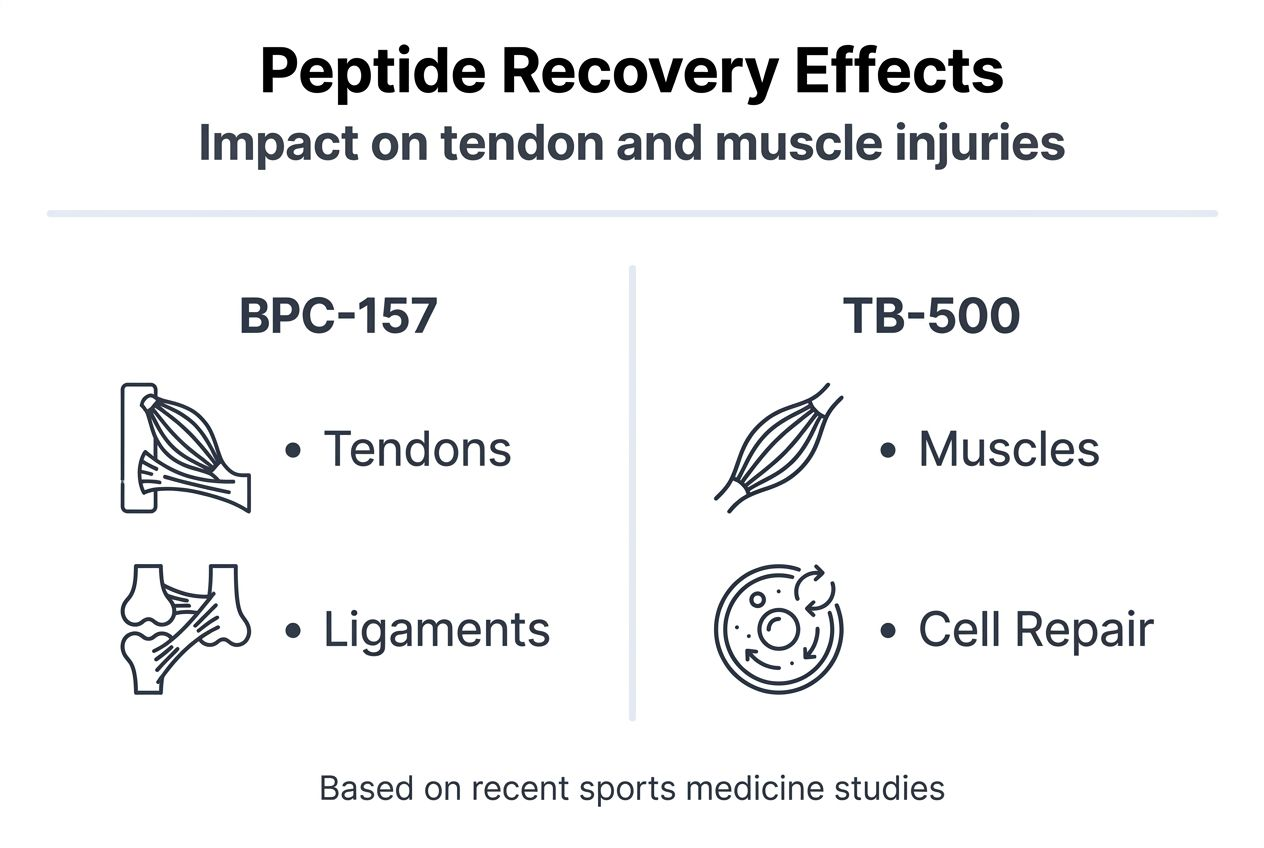
The following table summarises comparative peptide efficacy:
| Peptide | Best for injury type | Primary mechanism | Typical recovery improvement |
|---|---|---|---|
| BPC-157 | Tendons, ligaments | Angiogenesis, VEGF activation | 25-40% faster healing, 40% strength increase |
| TB-500 | Muscle tissue, wounds | Cell migration, actin regulation | 20-35% faster recovery, improved fibre diameter |
| Combined protocol | Complex injuries | Synergistic vascular and cellular effects | 30-45% overall improvement |
Functional outcomes extend beyond speed of healing. Biomechanical testing shows tissues treated with peptides often demonstrate superior strength and flexibility compared to naturally healed tissues. This translates to reduced re-injury risk, a critical consideration for athletes.
When selecting peptides based on injury type, consider:
- Tissue vascularity: Poorly vascularised tissues like tendons benefit more from BPC-157’s angiogenic properties
- Injury size: Larger tears may require TB-500’s enhanced cell migration capabilities
- Injury age: Chronic injuries often respond better to combined protocols addressing multiple healing deficits
- Individual response: Some athletes show preferential response to specific peptides based on genetic factors
For comprehensive guidance on peptide selection, review the research peptides recovery guide covering dosing strategies and timing protocols.
Common misconceptions about peptides in injury recovery
Misunderstanding peptide legality and safety creates unnecessary hesitation among athletes who could benefit from these therapies. Many athletes mistakenly believe all peptides are illegal performance enhancers, whereas several peptides are legally accepted in clinical rehabilitation contexts worldwide. The confusion stems from conflating therapeutic peptides with growth hormone secretagogues and other banned substances.
Peptides fall into distinct regulatory categories. BPC-157 and TB-500, whilst not approved as pharmaceutical drugs in many jurisdictions, are legal to purchase and use for research purposes. Athletes should verify their sport’s specific prohibited substance list, as regulations vary between organisations.
Another common misconception positions peptides as performance enhancers that provide unfair competitive advantages. In reality, therapeutic peptides restore normal healing capacity rather than creating superhuman recovery. They work with existing biological pathways, not against them. The distinction matters: peptides help injured tissue return to baseline function faster, they don’t enhance healthy tissue beyond normal capacity.
Safety concerns often arise from anecdotal reports or confusion with anabolic steroids. Properly sourced peptides typically show minimal adverse effects when used at therapeutic doses. Common side effects, when they occur, include mild injection site reactions or temporary fatigue. Serious complications are rare and usually associated with contaminated products or excessive dosing.
The belief that peptides replace physiotherapy represents perhaps the most damaging misconception. Peptides create favourable biological conditions for repair, but they cannot substitute for mechanical loading, range of motion work, and functional training that physiotherapy provides. Optimal outcomes require both:
- Peptides establish cellular and vascular conditions supporting tissue regeneration
- Physiotherapy provides mechanical stimuli guiding tissue organisation and strength development
- Combined approaches produce synergistic effects exceeding either treatment alone
- Neither peptides nor physiotherapy can compensate for inadequate rest or continued tissue damage
Pro tip: Before starting peptide therapy, verify current regulations for your sport and region. Rules change frequently, and what’s permitted in training may differ from competition periods.
For detailed safety information and quality considerations, consult the safe peptide selection guide and peptide safety explained resources.
Applying peptide therapy: practical guidance for athletes
Successful peptide integration requires systematic planning that aligns peptide therapy with conventional rehabilitation. Follow this four-step workflow:
-
Injury assessment: Obtain professional diagnosis identifying injury type, severity, and healing phase. Imaging studies help determine extent of tissue damage and guide realistic recovery timelines.
-
Peptide selection: Match peptide properties to injury characteristics. BPC-157 suits tendon and ligament injuries, particularly those with poor blood supply. TB-500 works better for muscle tears and wounds requiring cell migration.
-
Integration with physiotherapy: Design a coordinated programme where peptides support tissue-building phases whilst physiotherapy provides appropriate mechanical loading. Combined peptide therapy protocols with physiotherapy show synergistic effects improving functional recovery sustainability by 15-20%.
-
Monitoring and adjustment: Track recovery markers including pain levels, range of motion, strength measurements, and functional performance. Adjust peptide dosing and physiotherapy intensity based on progress.
Dosage and administration considerations include:
- Typical BPC-157 doses range from 200-500 micrograms daily, administered via subcutaneous injection
- TB-500 commonly uses 2-5 milligrams twice weekly during loading phases, then maintenance doses
- Injection timing relative to training affects outcomes, with post-workout administration often preferred
- Cycle length typically spans 4-8 weeks depending on injury severity and response
- Local injection near injury sites may enhance effects compared to systemic administration
Pro tip: Establish baseline measurements before starting peptide therapy. Document pain scores, range of motion, and strength metrics weekly to objectively assess treatment effectiveness and make data-driven adjustments.
Never attempt peptide therapy without professional guidance. Healthcare practitioners can help navigate dosing complexities, monitor for adverse effects, and integrate peptides with other treatments safely. For practical application strategies, explore using research peptides and the peptide application workflow guide.
Conclusion and next steps
Peptides offer athletes evidence-based tools for accelerating injury recovery and improving tissue repair quality. BPC-157 and TB-500 work through distinct biological mechanisms that complement conventional rehabilitation, potentially reducing recovery times by 20-35% whilst enhancing functional outcomes.
Success requires professional consultation before initiating peptide therapy. Healthcare providers can assess injury appropriateness, guide peptide selection, and monitor treatment safety. Combining peptides with structured physiotherapy produces superior results compared to either approach alone.
Ongoing research continues refining peptide protocols, dosing strategies, and applications for different injury types. Athletes should stay informed about emerging evidence whilst maintaining realistic expectations about peptide capabilities.
Explore the Northern peptides information page for comprehensive resources supporting informed peptide use in athletic recovery.
Discover peptide solutions to support your recovery
Optimising injury recovery requires access to quality information and reliable peptide sources.

Northern Peptides provides detailed educational resources through our peptide information page, covering everything from basic peptide science to advanced application protocols. Our peptide concentration calculator simplifies dosage planning, ensuring accurate reconstitution and administration.
Explore our research peptide catalogue featuring BPC-157, TB-500, and other compounds used in recovery research. We support athletes and researchers with expert guidance, quality assurance, and resources for evidence-based peptide use.
Frequently asked questions
What are peptides and how do they help with injury repair?
Peptides are short amino acid chains functioning as biological signals that trigger specific cellular responses. They accelerate injury repair by stimulating angiogenesis, enhancing fibroblast migration, and modulating inflammation to create optimal healing conditions.
Are peptide therapies legal and safe for athletes to use?
Many peptides used for injury repair exist in legal grey areas, permitted for research purposes but not approved as pharmaceutical drugs. Safety profiles are generally favourable when peptides are properly sourced and used under professional supervision. Athletes must verify their sport’s prohibited substance list, as regulations vary.
How should athletes integrate peptides with their rehabilitation programmes?
Peptides work synergistically with physiotherapy, not as standalone treatments. Successful integration requires professional injury assessment, appropriate peptide selection based on tissue type, coordinated timing with rehabilitation phases, and consistent monitoring of recovery markers to adjust protocols.
Which peptide is better for tendon injuries versus muscle injuries?
BPC-157 typically produces superior results for tendon and ligament injuries due to its angiogenic properties and ability to strengthen poorly vascularised tissues. TB-500 excels at muscle injury recovery through enhanced cell migration and muscle fibre regeneration. Combined protocols often work best for complex injuries.
How long does it take to see results from peptide therapy?
Initial improvements often appear within 1-2 weeks, with substantial functional gains emerging over 4-8 weeks. Timeline varies based on injury severity, tissue type, individual response, and integration with physiotherapy. Consistent monitoring helps identify response patterns and optimise treatment duration.