
Sourcing peptides is about more than just finding a supplier with quick delivery. For health and wellness professionals across North America, ethical sourcing is deeply connected to research integrity and legal accountability. Committing to responsible practices means your work stands up to scrutiny while protecting both your reputation and the future of your institution. In this overview, you will discover why ethical sourcing for research peptides defines quality, transparency, and long-term success in your field.
Table of Contents
- Defining Ethical Sourcing For Research Peptides
- Types Of Peptides And Sourcing Variations
- Canadian Regulatory Framework And Global Standards
- Impact On Product Purity, Safety, And Traceability
- Legal Risks Of Unethical Sourcing Practices
- Key Responsibilities For Formulators And Researchers
Key Takeaways
| Point | Details |
|---|---|
| Ethical Sourcing Importance | Sourcing peptides from transparent and compliant suppliers enhances research credibility and maintains institutional integrity. |
| Supplier Verification | Researchers must thoroughly vet suppliers for credentials and regulatory compliance before making purchases. |
| Documentation Necessity | Complete and batch-specific documentation is essential to validate the purity and safety of peptides sourced for research. |
| Ongoing Responsibilities | Researchers are accountable for maintaining proper storage, handling, and accurate record-keeping related to peptide sourcing throughout their projects. |
Defining ethical sourcing for research peptides
Ethical sourcing for research peptides means obtaining peptides from suppliers who maintain transparent practices, follow regulatory standards, and commit to quality at every step of the supply chain. This goes far beyond simply purchasing from any vendor who offers low prices or fast delivery. For research professionals in North America, ethical sourcing directly impacts your credibility, your institution’s reputation, and the validity of your research outcomes. When you source peptides ethically, you’re making a deliberate choice to support suppliers who can document their manufacturing processes, verify the purity of their products, and maintain chains of custody that hold up under scrutiny.
The core components of ethical sourcing include several interconnected practices. First, your supplier must demonstrate verifiable manufacturing standards that comply with regulations governing research chemicals in your jurisdiction. This means they maintain detailed records of synthesis, purification, and testing. Second, suppliers should provide comprehensive documentation including certificates of analysis, authenticity verification, and batch traceability. Third, ethical sourcing requires suppliers to operate with transparency about their sourcing origins, meaning they can explain where raw materials come from and why specific production methods were chosen. Finally, there’s the commitment to responsible stewardship, which includes proper waste disposal, environmental consideration, and adherence to ethical guidelines that prevent misuse of research materials. The Northern Peptides educational resources can provide additional context on industry standards and best practices that inform these sourcing principles.
Why does this matter to your work specifically? When you work with ethically sourced peptides, you eliminate downstream complications that derail research projects. Contaminated peptides lead to failed experiments, wasted resources, and corrupted data. Peptides from suppliers without proper documentation create regulatory headaches when you need to publish or submit your findings for institutional review. Poor sourcing practices also expose your research to questions about integrity that can damage professional relationships and institutional credibility. Conversely, when you document that your peptides came from suppliers meeting ethical standards, reviewers, funding agencies, and collaborators trust your methodology from the outset. This trust becomes increasingly valuable as research standards tighten and as funding bodies demand greater accountability for how research materials are obtained.
The practical reality is that ethical sourcing requires asking harder questions upfront rather than discovering problems later. You need suppliers who can answer detailed questions about their quality assurance processes, who provide batch specific documentation rather than generic certificates, and who maintain relationships based on long term reliability rather than transaction based pricing. Your supplier should be able to explain exactly which testing methods were used, what the specifications mean, and how their peptides compare to competitors in meaningful ways beyond just price point. This demands more from suppliers, which is precisely why ethical sourcing represents a meaningful differentiator in the research peptide market.
Pro tip: Before committing to a new supplier, request their quality documentation for a specific batch and cross reference the testing methods against your institutional standards, then ask for references from other research groups currently using their products to validate their reliability claims.
Types of peptides and sourcing variations
Research peptides come in many different forms, and understanding these variations is crucial to making informed sourcing decisions. The peptide market isn’t homogeneous, which means the supplier and sourcing approach that works for one peptide type may create significant problems for another. Different peptide categories have distinct manufacturing requirements, purity standards, stability profiles, and regulatory considerations that directly affect which suppliers can ethically deliver what you need. Your sourcing strategy must account for these differences, or you’ll find yourself working with suppliers who lack expertise in the specific peptides your research requires.
The primary distinction exists between synthetic peptides and naturally derived peptides. Synthetic peptides are manufactured through chemical synthesis, typically via solid phase peptide synthesis or liquid phase synthesis, which gives manufacturers precise control over amino acid sequences and allows for high purity levels. These peptides are often customisable, meaning researchers can request specific modifications or sequences tailored to their experiments. The advantage is reproducibility, consistency, and the ability to obtain detailed documentation about the entire synthesis process. Naturally derived peptides are extracted or isolated from biological sources such as animal tissues, plant materials, or microbial cultures. These peptides tend to have more complex profiles because they contain multiple bioactive compounds alongside the target peptide, which introduces variability between batches. Sourcing naturally derived peptides ethically requires suppliers who can document sustainable harvesting practices, quality control for contaminants, and transparent information about their source materials.
Within the research peptide landscape, you’ll encounter several functional categories that require different sourcing approaches. Peptides like BPC 157 and TB500 represent therapeutic research peptides that have generated significant academic interest and require suppliers with rigorous quality standards and batch documentation. Research compounds derived from metabolic pathways demand suppliers who understand regulatory nuances around pharmaceutical precursors. Peptides used for structural studies need extremely high purity and consistent specifications across batches. The sourcing variations become apparent when you consider that a supplier excelling at producing peptides for structural research might lack the expertise needed for functional studies, or vice versa. Additionally, some peptides require refrigeration and careful handling throughout distribution, while others remain stable at room temperature, affecting both sourcing logistics and supplier capabilities. The research peptide catalog can help you identify peptides suited to your specific research needs and understand their handling requirements.

Geographic sourcing also introduces meaningful variations. Peptides sourced from suppliers in different regions may have different regulatory oversight, quality standards, and documentation practices. North American suppliers typically operate under stricter regulatory frameworks compared to overseas manufacturers, which affects pricing but also provides greater assurance regarding quality control consistency. Some researchers prefer domestic sourcing specifically because it simplifies regulatory traceability and institutional compliance. Others source peptides from multiple geographic regions as part of risk mitigation strategies, ensuring they aren’t dependent on a single supplier or production facility. The ethical consideration here isn’t simply about choosing the cheapest option from any region, but rather selecting suppliers whose quality standards, transparency practices, and regulatory compliance meet your institution’s requirements regardless of where manufacturing occurs.
Here’s a comparison of synthetic and naturally derived research peptides to clarify sourcing considerations:
| Peptide Type | Sourcing Challenges | Purity Levels | Typical Documentation |
|---|---|---|---|
| Synthetic Peptides | Requires precise synthesis control | Very high (≥95%) | Full synthesis records |
| Naturally Derived Peptides | Source variability and batch differences | Moderate to variable | Details on source origin |
| Both Types | Regulatory requirements vary regionally | Traceability is crucial | |
| Detailed certificates needed |
Pro tip: Before sourcing a new peptide type, identify three potential suppliers and request their full quality documentation, then check which peptide categories they specialise in rather than assuming all suppliers can deliver equivalent quality across all peptide types.
Canadian regulatory framework and global standards
Canada’s approach to regulating research peptides operates within a distinct legal framework that differs meaningfully from other countries, and understanding this landscape is essential for any researcher or formulator working in North America. Health Canada serves as the primary regulatory authority overseeing peptides, and the agency maintains clear boundaries around what constitutes legal possession, distribution, and use. Unlike some jurisdictions where peptides operate in regulatory grey zones, Canada has established explicit rules: peptides are permitted strictly for scientific research purposes, they cannot be marketed or sold for human consumption, and they must carry clear labelling designating them “For Research Use Only.” This isn’t simply a procedural requirement—it fundamentally shapes your sourcing obligations and your relationship with suppliers. When you source peptides in Canada, you’re operating within a regulatory environment that demands transparency, documentation, and compliance at every transaction point.
The Canadian regulatory framework requires several specific elements from both suppliers and researchers. Suppliers must be licensed and possess the proper authorisation to manufacture or distribute research chemicals. They must provide certificates of analysis for every batch, which document purity levels, composition verification, and testing methodologies used. Researchers purchasing peptides in Canada must source exclusively from licensed suppliers and maintain records demonstrating research use compliance. The peptides themselves cannot be accompanied by medical claims, health benefit assertions, or therapeutic language of any kind. Importing unverified peptides or sourcing from unlicensed suppliers creates legal exposure, not just for your institution but for you personally. Additionally, selling research peptides for personal use or non-research applications directly violates Canadian law, regardless of whether the peptide itself was legally sourced. This creates a responsibility chain where every person handling the peptide bears accountability for ensuring it remains within its intended research context.
Global standards introduce another layer of complexity because many research institutions work with international collaborators or consider sourcing from suppliers outside Canada. The European Union maintains its own regulatory framework through ECHA and REACH regulations, which in many cases impose stricter requirements than Canadian standards. The United States regulates research chemicals through the DEA and FDA depending on classification, with standards that sometimes align with Canada but often diverge in meaningful ways. China, India, and other manufacturing hubs operate under different regulatory oversight entirely, which affects quality consistency and documentation reliability. When you source globally, you’re essentially working with multiple regulatory systems simultaneously. A peptide that meets Canadian standards might not meet European standards for purity, or it might contain residual solvents acceptable in one jurisdiction but prohibited in another. The ethical approach involves recognising that stricter global standards exist and choosing suppliers who meet the highest applicable standard rather than simply meeting the minimum requirement in your home jurisdiction. This approach protects your research integrity and ensures your work holds credibility when presented to international audiences or submitted for publication.
The practical reality for researchers in Canada is that domestic sourcing from licensed suppliers, while potentially more expensive than overseas alternatives, provides clear compliance advantages. Licensed Canadian suppliers understand the regulatory landscape intimately, maintain proper documentation systems, and operate under oversight that creates accountability. When regulatory bodies or institutional review committees question your sourcing practices, you can point to domestic licensed suppliers with verified credentials and detailed batch documentation as evidence of ethical sourcing. International sourcing creates documentation burdens and verification challenges that can derail projects or delay publication. Your institution’s research integrity office likely has policies preferring or requiring domestic sourcing for precisely this reason. Building relationships with Canadian suppliers who specialise in your peptide types creates long term advantages beyond simple compliance—it establishes a trusted source for consistent quality, reliable documentation, and expert guidance on handling and storage requirements specific to your research needs.
Below is a summary of Canadian versus global peptide regulatory standards for easier reference:
| Region | Key Authority | Notable Requirements | Compliance Advantage |
|---|---|---|---|
| Canada | Health Canada | For research use only, licensing needed | Strong traceability; easier audits |
| European Union | ECHA/REACH | Strict purity, environmental controls | Stringent batch documentation |
| United States | DEA/FDA | Varies by chemical/drug class | Complex import rules |
| Asia (China, India) | National agencies | Variable; less oversight in some cases | May offer lower cost, but higher risk |
Pro tip: Verify that any peptide supplier you consider is explicitly licensed by Health Canada and request their licence documentation before committing to a purchase, then confirm they provide batch-specific certificates of analysis rather than generic product specifications.
Impact on product purity, safety, and traceability
Ethical sourcing directly determines whether your research peptides arrive pure, safe, and fully documented—or whether they arrive compromised, contaminated, and impossible to defend. This isn’t theoretical. When peptides lack proper sourcing oversight, impurities accumulate through every stage of the supply chain. Manufacturing shortcuts introduce unwanted byproducts. Storage conditions go unmonitored. Handling protocols get skipped. By the time peptides reach your laboratory, they may contain heavy metals, residual solvents, bacterial endotoxins, or completely unexpected compounds that destroy your experimental results. Worse, you won’t know it until after you’ve invested time, resources, and intellectual energy into experiments that ultimately fail or produce meaningless data. Ethical sourcing prevents this catastrophic scenario by ensuring suppliers implement rigorous quality controls from synthesis through delivery.
Purity represents the first critical impact. When suppliers cut corners on ethical sourcing, they skip expensive purification steps or use cheaper purification methods that don’t remove all contaminants. A peptide advertised as 95 per cent pure might actually be 87 per cent pure, with the remaining material consisting of unreacted starting materials, synthesis intermediates, or decomposition products. These impurities don’t just dilute your peptide—they actively interfere with experiments. They bind to receptors, trigger unintended biological responses, or create measurement artefacts that corrupt your data. Ethically sourced peptides come with detailed certificates of analysis that document exactly what testing methods were used, what the purity results showed, and what impurities were detected at what concentrations. This documentation allows you to make informed decisions about whether the peptide meets your experimental requirements. Beyond purity percentages, ethical sourcing ensures suppliers test for specific contaminants relevant to research applications, including endotoxin levels that matter for cell culture studies, heavy metal content that affects sensitive analytical techniques, and residual solvents that might interfere with protein interactions. When you compare peptides from ethically sourced suppliers to those from questionable sources, the difference in documentation quality becomes immediately apparent. One supplier provides a generic certificate saying “95 per cent pure.” Another supplier provides detailed breakdown of composition, detection limits for contaminants, and the specific high-performance liquid chromatography parameters used for analysis.
Safety implications extend beyond your experiments to encompass laboratory personnel, institutional liability, and research credibility. Peptides containing bacterial endotoxins pose direct health risks when handled improperly or when they contaminate cell culture media. Heavy metals create occupational exposure hazards for anyone working with the materials. Unlabelled or mislabelled peptides create confusion that leads to incorrect usage and potential accidents. Ethically sourced peptides arrive with safety data sheets, proper labelling, storage instructions, and handling protocols that protect your team. Your institution’s occupational health and safety office requires this documentation before allowing research staff to handle any chemical compound. Beyond immediate safety, sourcing from suppliers without ethical practices exposes your institution to liability. If a researcher becomes ill or if contaminated peptides somehow enter the broader supply chain, your institution faces questions about due diligence. Did you verify the supplier’s credentials? Can you document the peptide’s chain of custody? Do you have batch documentation proving what you received? Institutions with strong ethical sourcing practices answer these questions confidently. Those without face potential regulatory investigations, reputational damage, and legal consequences.
Traceability creates the final critical impact. Ethical sourcing means every peptide batch remains traceable from synthesis through your laboratory. This matters tremendously when you need to publish research or when regulatory bodies ask questions about your methodology. A complete chain of custody documentation shows exactly which supplier manufactured the peptide, when it was synthesised, which testing was performed, what storage conditions were maintained, and where the material went. This traceability allows you to replicate experiments exactly, defend your methodology against scrutiny, and troubleshoot problems systematically if something goes wrong. Without traceability, you face situations where you cannot explain why results differ between batches, cannot verify what you actually tested, or cannot reproduce findings because you don’t know the exact composition of the materials you used. When research institutions and funding agencies evaluate ethical sourcing practices, traceability documentation represents perhaps the most compelling evidence of integrity. You can point to specific batch numbers, dates, supplier credentials, and testing results that demonstrate you sourced peptides responsibly. Unethical sourcing practices involve vague supplier information, missing batch documentation, unclear testing methods, and gaps in the supply chain that cannot be explained or verified.
Pro tip: Create a sourcing documentation template for your laboratory that captures supplier credentials, batch numbers, certificate of analysis details, and storage conditions for every peptide you acquire, then store these records alongside your experimental data so you can always defend your methodology and troubleshoot quality issues.
Legal risks of unethical sourcing practices
Unethical sourcing of research peptides isn’t a grey area or a minor compliance concern. It creates concrete legal exposure that can destroy careers, shut down research programmes, and expose institutions to regulatory sanctions that extend far beyond simple fines. The legal risks operate on multiple levels simultaneously, affecting individual researchers, institutions, and anyone involved in the supply chain. Many researchers underestimate these risks because they assume that as long as they use peptides for research rather than human administration, legal exposure remains minimal. This assumption is dangerously incorrect. Regulatory agencies, institutional review boards, and law enforcement take a far dimmer view of unethical sourcing practices than most people realise. When you source peptides from suppliers operating outside regulated pharmaceutical supply chains, you cross into territory where serious legal consequences become not just possible but increasingly likely.
The fundamental legal issue centres on the distinction between research peptides and pharmaceutical peptides, and the critical requirement that clinical distribution of peptides requires authorised suppliers. This distinction matters tremendously because it determines whether sourcing from certain suppliers constitutes a legal violation. Research peptides obtained from licensed suppliers for documented research purposes operate in a legally protected space. However, sourcing peptides from unlicensed suppliers, importing unverified materials, or using peptides in ways that blur the line between research and therapeutic application creates immediate legal jeopardy. If regulatory bodies determine that you obtained peptides outside authorised channels, the fact that you labelled them “for research use only” provides no legal protection. Prosecutors and regulatory agencies look at actual intended use, not marketing labels. If evidence suggests peptides were distributed to patients, used clinically, or marketed therapeutically, you face charges regardless of how they were originally labelled. This creates legal exposure spanning regulatory sanctions, civil lawsuits, and potentially criminal penalties depending on severity and intent.
Regulatory consequences manifest through multiple enforcement mechanisms that institutions and individuals can barely survive. Health Canada, provincial regulatory bodies, and the Canadian Food and Inspection Agency possess authority to suspend licences, impose substantial fines, and require institutional overhauls in response to unethical sourcing practices. If your institution is caught sourcing peptides unethically, expect investigations that scrutinise not just the sourcing decision but your entire research governance structure. Reviewers will question whether your institutional review board properly vetted suppliers. They will examine whether your research ethics committee understood the legal distinctions between approved and unapproved materials. They will demand documentation showing how you verified supplier credentials and maintained chains of custody. Institutions facing regulatory investigation often find that initial sourcing violations expand into broader compliance failures that regulators use as justification for harsh penalties. Beyond regulatory sanctions, civil lawsuits emerge when peptide sourcing failures harm research participants or when contaminated materials cause injury. If someone becomes ill or suffers complications traceable to unethically sourced peptides, liability falls directly on your institution and potentially on you personally. Insurance policies rarely cover deliberate compliance violations, which means you face financial exposure without institutional protection.
Criminal liability represents the most serious legal consequence. Deliberately sourcing peptides from unlicensed suppliers, falsifying documentation, misrepresenting peptide composition, or knowingly distributing unapproved materials can trigger criminal charges including fraud, drug trafficking charges in certain contexts, and conspiracy depending on how authorities characterise your conduct. Criminal investigations move slowly but relentlessly, and once they begin, your institution faces mandatory cooperation requirements and potential criminal charges that extend to institutional leadership. Individual researchers have faced criminal prosecution for sourcing peptides unethically, resulting in fines, professional licence suspension, and in severe cases, imprisonment. The institutional response to criminal investigation typically involves abandoning the researcher to protect the institution, leaving individuals without organisational support while facing legal proceedings. Beyond these formal legal mechanisms, unethical sourcing creates professional consequences that effectively end careers. Publications based on unethically sourced peptides face retraction, grant funding disappears when agencies learn about sourcing violations, and your professional reputation suffers damage that persists for decades. Colleagues distance themselves from researchers implicated in sourcing scandals. Collaborators withdraw from joint projects. Your ability to obtain future funding, secure positions, or maintain credibility in your field evaporates.
The practical legal reality is that ethical sourcing represents the only rational business decision. Using licensed suppliers with verified credentials, maintaining complete documentation of sourcing decisions, and ensuring your institution’s compliance officers review peptide sourcing practices creates a legal shield that protects you if questions ever arise. When regulatory bodies or law enforcement examine your sourcing practices, detailed documentation demonstrating due diligence becomes your best defence. You can show that you obtained peptides from licensed suppliers, verified their credentials, requested and reviewed certificates of analysis, and maintained records showing research use compliance. This documentation doesn’t guarantee legal immunity, but it demonstrates that you acted reasonably and in good faith. Conversely, unethical sourcing creates an indefensible position. You cannot justify sourcing from unlicensed suppliers. You cannot explain missing documentation. You cannot defend the decision to skip verification steps. The legal system will interpret these failures as evidence of knowing misconduct rather than inadvertent oversight.
Pro tip: Work with your institution’s legal counsel and compliance office before sourcing any peptides to understand what documentation they require, what supplier verification processes must occur, and what records you must maintain so you build legal defensibility into your sourcing practices from the beginning.
Key responsibilities for formulators and researchers
Responsibility for ethical sourcing doesn’t rest with suppliers alone. Formulators and researchers bear specific, non-negotiable obligations that begin the moment you decide to work with peptides and continue throughout your research lifecycle. These responsibilities extend beyond simply purchasing from any vendor offering peptides. They require active engagement with supplier vetting, documentation maintenance, and ongoing verification that materials meet your standards. Many researchers treat sourcing as a administrative checkbox rather than a core research integrity practice. This creates significant problems. Your institution, your funding agencies, and regulatory bodies hold you personally accountable for the sourcing decisions you make. When something goes wrong, the question won’t be “Did the supplier fail to provide proper documentation?” The question will be “Why didn’t you verify the supplier’s credentials before purchasing?” Understanding and embracing your sourcing responsibilities transforms ethical peptide sourcing from a compliance burden into a fundamental research practice that strengthens everything you do.
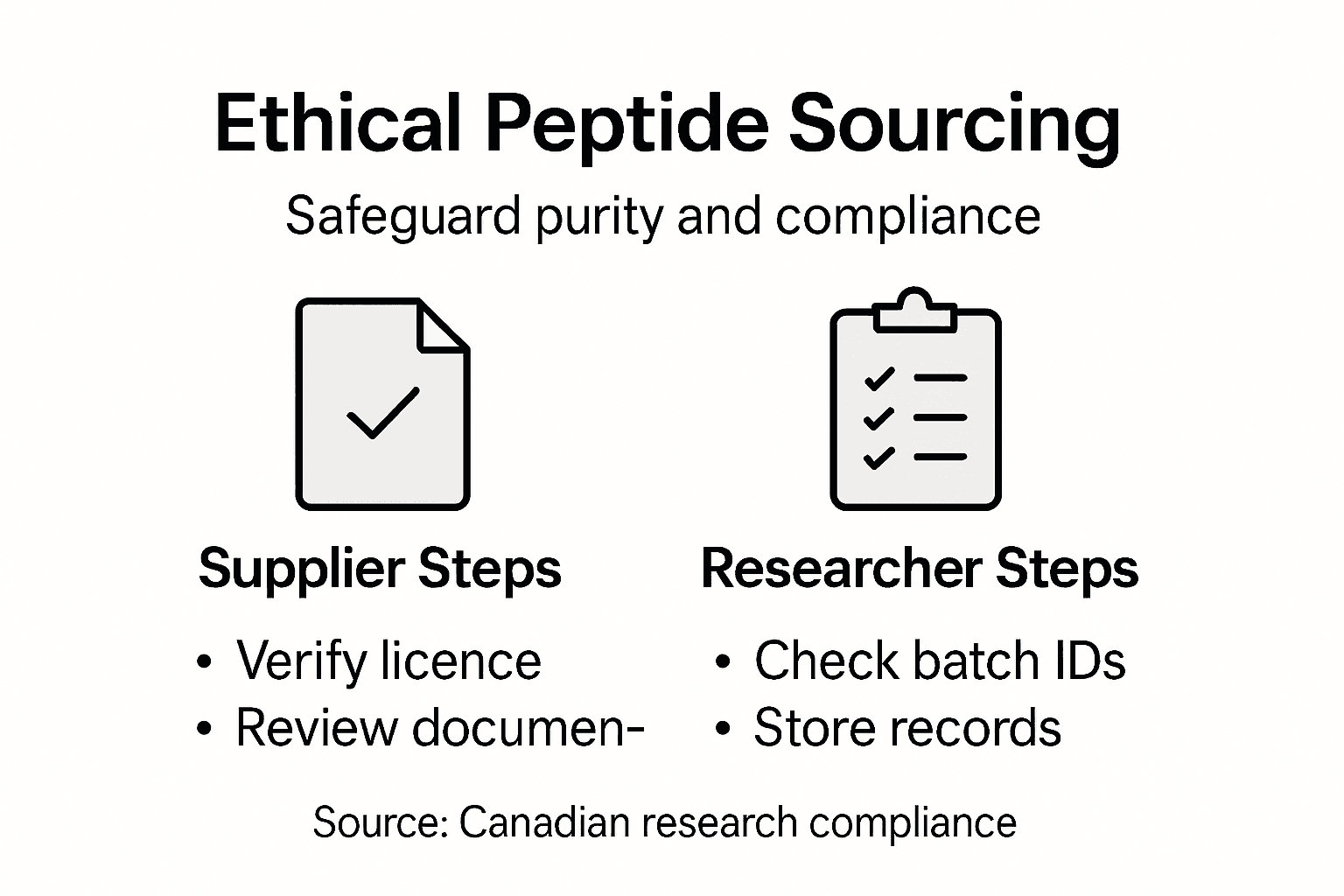
Your first responsibility involves supplier verification and credentialling. Before you make any purchase, you must thoroughly investigate your supplier’s background, licensing status, quality systems, and reputation within the research community. This means checking whether they hold valid licences in the jurisdictions where they manufacture or distribute peptides. For Canadian suppliers, verify their standing with Health Canada and relevant provincial bodies. Request documentation proving their compliance with quality standards. Ask for references from other researchers currently using their products. Check whether they have history of regulatory violations or quality issues. Many researchers skip this step because it feels time consuming. It is time consuming. That’s precisely why it matters. Suppliers operating ethically welcome detailed verification questions because they have nothing to hide. Suppliers cutting corners often become evasive or defensive when you ask too many questions. These red flags should end your sourcing relationship immediately. Your institution likely has procurement policies requiring supplier verification. Follow those policies exactly. If your institution lacks formal supplier vetting procedures, work with your compliance office to establish them. Don’t source peptides from suppliers you haven’t thoroughly evaluated.
Your second responsibility involves obtaining and reviewing complete documentation. Every peptide you source must arrive with certificates of analysis documenting purity, composition, and testing methods used. Don’t accept generic certificates. Demand batch specific documentation showing exactly what testing was performed on exactly what you received. Review the certificate carefully. Understand what the purity percentage means. Identify what impurities are present and at what concentrations. Confirm that research peptide sourcing requirements align with your experimental needs. Request safety data sheets providing handling, storage, and hazard information. If documentation is missing or incomplete, reject the shipment and source from a different supplier. Maintain all documentation alongside your experimental records. This creates a chain of custody that demonstrates due diligence if questions ever arise. Many researchers assume suppliers provide adequate documentation automatically. They don’t. You must request it, verify its completeness, and confirm it meets your institutional standards. Documentation gaps represent your red flag to reconsider whether you trust the supplier.
Your third responsibility involves maintaining proper storage and handling. Peptides degrade under improper conditions, which introduces variability that corrupts experiments. Follow the supplier’s storage instructions exactly. If peptides require refrigeration, refrigerate them. If they require protection from light, protect them from light. If they need to stay dry, maintain appropriate humidity conditions. Document storage conditions in your laboratory notebook or digital records. When you use peptides, handle them according to protocols provided by your supplier. Train all laboratory personnel on proper peptide handling. Don’t assume that because peptides are “research materials” they don’t require careful handling. Poor storage and handling practices introduce the same contaminants and purity issues that unethical suppliers create. You become responsible for quality degradation if you fail to maintain proper storage conditions. This responsibility extends throughout your research. Even ethically sourced, properly documented peptides become problematic if you store them improperly or handle them negligently.
Your fourth responsibility involves accurate record keeping and transparency. Document exactly which peptides you sourced, from which supplier, when you received them, which batch number you used in experiments, and what results you obtained. If you later discover quality issues or if questions arise about your methodology, this documentation allows you to trace problems to their source. Maintain these records as part of your research data. When publishing research, be prepared to disclose sourcing information. If your institution requires it, provide documentation proving you sourced peptides ethically. Don’t hide sourcing information or downplay sourcing practices. Transparency about sourcing decisions demonstrates confidence in your sourcing practices and builds credibility with reviewers and collaborators. Conversely, reluctance to disclose sourcing details raises questions about whether you’re hiding problematic sourcing decisions.
Pro tip: Create a sourcing checklist for your laboratory that includes supplier verification steps, documentation requirements, storage protocols, and record keeping procedures, then use this checklist before sourcing any new peptide so you standardise ethical sourcing practices across your research team.
Ensure Your Research Peptides Are Ethically Sourced and Compliant
Navigating the complex demands of ethical sourcing for peptides is critical to safeguarding your research integrity. If you have faced challenges such as supplier verification, obtaining detailed batch documentation, or ensuring Canadian regulatory compliance, you are not alone. The risks of compromised purity, safety concerns, and legal exposure are real, but they can be avoided by partnering with trustworthy suppliers who prioritise transparency and quality.
At Northern Peptides, we understand these pain points and provide a comprehensive solution that supports your commitment to ethical sourcing. Visit our Uncategorized – Northern peptides resource hub to deepen your knowledge and leverage our supply of high-quality research peptides backed by full documentation and licencing credentials.

Take control of your peptide sourcing now with confidence. Explore our offerings and educational resources at Northern Peptides and make informed decisions that protect your work, institution, and career. Start sourcing ethically today and avoid costly pitfalls. Learn more and connect with trusted suppliers through our platform and ensure every peptide you use meets the highest standards of research compliance and traceability.
Frequently Asked Questions
What is ethical sourcing for research peptides?
Ethical sourcing for research peptides involves obtaining peptides from suppliers who maintain transparent practices, follow regulatory standards, and commit to quality throughout the supply chain. This entails verifying manufacturing standards, documentation, sourcing origins, and responsible stewardship to ensure credibility and research integrity.
Why is proper documentation important when sourcing peptides?
Proper documentation ensures that the peptides meet purity standards, verifies that safety protocols are followed, and allows for traceability throughout the supply chain. This is crucial for maintaining research integrity and compliance with regulatory requirements, making it easier to defend methodology in publications.
How do synthetic peptides differ from naturally derived peptides in terms of sourcing?
Synthetic peptides are chemically manufactured, allowing for precise control over amino acid sequences and ensuring high purity levels, while naturally derived peptides come from biological sources and may have more variability in composition. The sourcing strategies for these two types differ due to their distinct manufacturing and quality control requirements.
What are the legal risks associated with unethical sourcing practices for peptides?
Unethical sourcing can lead to serious legal consequences, including regulatory sanctions, civil lawsuits, and even criminal penalties. These risks arise from sourcing materials from unlicensed suppliers or using peptides outside their intended research context, which exposes researchers and institutions to accountability and liability.