
Precision makes all the difference when it comes to anti-aging strategies and fitness breakthroughs. For those navigating the science of performance enhancement, understanding peptide terminology is crucial for effective results and safety. Whether you are researching new therapies or optimising your training, this guide clarifies essential definitions and distinctions every Canadian health professional and fitness enthusiast should know for informed, evidence-based decisions.
Table of Contents
- Research Peptide Terminology Defined Clearly
- Major Categories and Types of Peptides
- Essential Terms for Quality and Safety
- Legal Labelling and Use in Canada 2026
- Risks, Mislabeling, and Common Mistakes
Key Takeaways
| Point | Details |
|---|---|
| Peptide Structures | Peptides are short chains of amino acids with distinct biological roles in medical and fitness research. |
| Classification Nuances | Understanding the various peptide categories is essential for targeted research applications. |
| Quality Control Importance | Rigorous documentation and validation practices are crucial for ensuring peptide integrity and reliability. |
| Regulatory Awareness | Staying updated with Canadian regulations is vital for proper labelling and compliance in peptide research. |
Research Peptide Terminology Defined Clearly
In scientific research, precision isn’t just important—it’s everything. Understanding peptide terminology requires distinguishing subtle yet critical definitions that drive biological comprehension. Peptide structures represent intricate molecular arrangements with profound implications for medical and fitness research.
Peptides are fundamentally short chains of amino acids, typically ranging between 2 and 50 amino acid residues connected through peptide bonds. These molecular structures serve diverse biological functions:
- Act as hormonal signaling molecules
- Function as antibiotic agents
- Facilitate cellular communication
- Trigger specific metabolic responses
The technical differentiation between peptides and proteins hinges on chain length. While peptides consist of fewer than 50 amino acids, polypeptides and proteins exceed this threshold, assembling into more complex molecular structures. Amide bond formations/26%3A_Biomolecules-_Amino_Acids_Peptides_and_Proteins/26.05%3A_Peptides_and_Proteins) create these intricate molecular connections, enabling remarkable biochemical interactions.
Researchers must understand key terminological nuances. Every peptide possesses an N-terminal and C-terminal residue, with unique chemical properties determined by specific amino acid sequences. This precision enables targeted research across medical, fitness, and pharmaceutical domains.
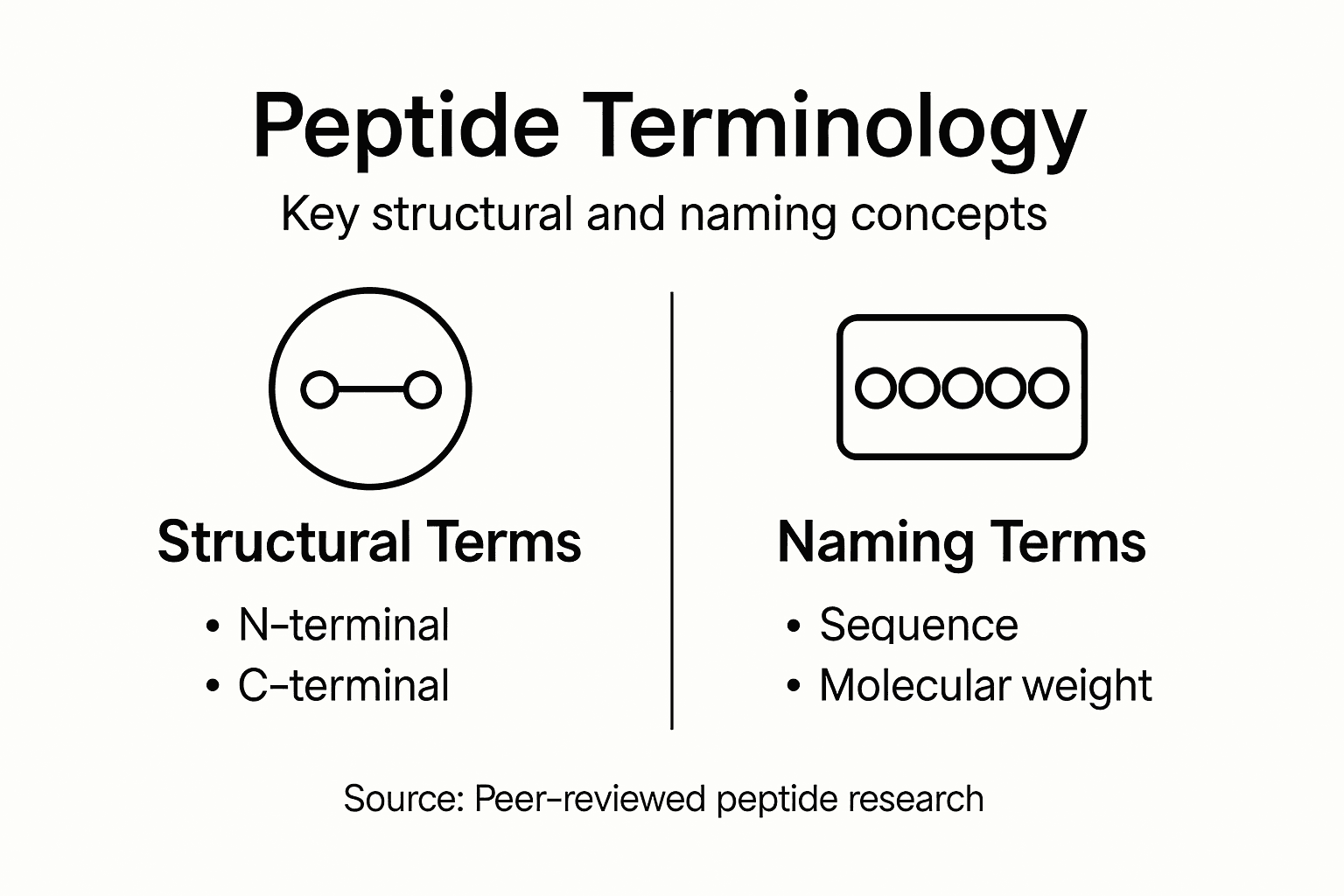
Pro tip: When reviewing peptide research, always verify the exact amino acid sequence and molecular weight to ensure accurate scientific interpretation.
Major Categories and Types of Peptides
Peptides represent a diverse molecular landscape with intricate classifications that reflect their complex biological roles. Peptide categories span multiple dimensions, including length, structural configuration, and physiological function, making them critical tools in medical and fitness research.
Fundamental peptide classifications include:
- Oligopeptides: Short amino acid chains
- Polypeptides: Longer molecular chains
- Cyclic peptides: Circular molecular structures
- Non-ribosomal peptides: Synthesized outside traditional protein synthesis mechanisms
Functionally, peptides can be further categorized based on their biological interactions:
- Hormonal peptides
- Antimicrobial peptides
- Neuropeptides
- Venom peptides
- Tumour-related peptides
Therapeutic peptide classifications reveal even more nuanced distinctions. Endogenous peptides encompass critical biological regulators like neuropeptides, hormones, and modulatory compounds. Researchers distinguish between endocrine peptides, opioid peptides, and immune-related peptides, each with unique molecular signatures and physiological impacts.
The complexity of peptide categorization extends beyond simple taxonomic descriptions. Chemical modifications, synthesis pathways, and structural features like disulfide bridges provide additional layers of molecular understanding that enable targeted research and therapeutic interventions.

Here’s a concise overview comparing different peptide categories and their typical research applications:
| Peptide Category | Structural Feature | Typical Research Application |
|---|---|---|
| Oligopeptides | Short linear chains | Cell signalling studies |
| Polypeptides | Extended chains | Protein engineering research |
| Cyclic peptides | Ring-structured chains | Drug development and stability |
| Non-ribosomal peptides | Non-template synthesis | Antibiotic and natural product screening |
Pro tip: Always examine the specific amino acid sequence and structural characteristics when classifying peptides to ensure precise scientific interpretation.
Essential Terms for Quality and Safety
In the intricate world of peptide research, understanding key quality and safety terminology is paramount. Reference standards form the cornerstone of ensuring peptide integrity and reliability across scientific and medical applications.
Critical quality and safety terms include:
- Reference standards: Benchmark measurements for peptide characteristics
- Process validation: Systematic documentation of manufacturing consistency
- Impurities: Unwanted molecular variations in peptide composition
- Analytical methods: Scientific techniques for measuring peptide properties
Specific analytical techniques play a crucial role in peptide assessment:
- High-Performance Liquid Chromatography (HPLC)
- Mass Spectrometry
- Protein sequencing
- Spectroscopic analysis
Good documentation practices represent another fundamental aspect of peptide research quality control. These practices ensure data integrity through comprehensive batch records, standard operating procedures (SOPs), and rigorous change control mechanisms.
Regulatory compliance demands meticulous attention to manufacturing processes. Researchers must maintain detailed documentation tracking every stage of peptide development, from initial synthesis to final characterization, to guarantee reproducibility and safety.
Pro tip: Always maintain comprehensive documentation and cross-reference multiple analytical methods when assessing peptide quality to ensure maximum research reliability.
Legal Labelling and Use in Canada 2026
Navigating the complex landscape of peptide regulation requires a comprehensive understanding of Canadian legal frameworks. Food and Drug Regulations provide the foundational guidelines for peptide labelling, distribution, and use across scientific and medical domains in Canada.
Key regulatory requirements for peptide labelling include:
- Bilingual labelling: Information must appear in both English and French
- Ingredient identification: Complete and accurate molecular composition
- Potency claims: Scientifically verified performance statements
- Safety warnings: Comprehensive risk disclosure
- Market approval documentation: Mandatory pre-release certifications
The regulatory landscape demands meticulous attention to several critical aspects:
- Precise molecular characterization
- Comprehensive safety documentation
- Transparent ingredient listings
- Rigorous quality control evidence
- Consistent compliance with updated standards
Manufacturers and researchers must remain vigilant about evolving regulatory requirements. Canadian authorities continuously update guidelines to reflect emerging scientific understanding and ensure public safety. This dynamic approach means peptide developers must maintain flexible documentation processes and stay current with the latest regulatory modifications.
This table summarizes best practices for quality, safety, and compliance in Canadian peptide research:
| Practice Area | Key Requirement | Research Benefit |
|---|---|---|
| Quality Assurance | Multi-point batch documentation | Ensures reproducibility |
| Analytical Validation | Use of multiple assessment methods | Enhances measurement accuracy |
| Regulatory Compliance | Up-to-date bilingual labelling | Satisfies Canadian regulations |
| Documentation | Adherence to ALCOA+ principle | Maintains data integrity |
Pro tip: Consult legal experts specializing in Canadian health regulations to ensure your peptide documentation meets the most current compliance standards.
Risks, Mislabeling, and Common Mistakes
Peptide research demands absolute precision, where even minor errors can have significant consequences. Specimen mislabeling represents a critical risk that can compromise scientific integrity and patient safety.
Common mislabeling risks include:
- Incorrect sequence information
- Source misidentification
- Transcription errors
- Contamination events
- Improper storage conditions
Potential consequences of these mistakes range from:
- Therapeutic ineffectiveness
- Unexpected allergenic reactions
- Compromised research data
- Regulatory non-compliance
- Financial and reputational damage
Good documentation practices provide a critical framework for minimizing these risks. The ALCOA+ principle ensures documentation is Attributable, Legible, Contemporaneous, Original, Accurate, and Complete. This systematic approach helps researchers maintain the highest standards of scientific precision and regulatory compliance.
Researchers must implement rigorous quality control processes, including multiple verification steps, standardized documentation protocols, and comprehensive training programs to mitigate the potential for human error.
Pro tip: Develop a systematic double-verification process for all peptide documentation to catch potential mislabeling before it becomes a critical issue.
Achieve Precision in Peptide Research with Expert Resources
Understanding complex peptide terminology and ensuring accuracy in your research can be challenging. With the risks of mislabeling, regulatory requirements, and the need for clear documentation, every detail matters to guarantee the quality and safety of your peptide projects. Our expertise in research peptides, chemicals, and educational support helps you navigate these challenges with confidence.

Explore our carefully curated resources and product selections designed to meet the highest standards of peptide quality and compliance. Visit Uncategorized – Northern peptides for insights and practical tools tailored for researchers. Start elevating your peptide work now by accessing comprehensive solutions at Northern Peptides main site. Let us help you maintain precision and reliability every step of the way.
Frequently Asked Questions
What is the difference between peptides and proteins?
Peptides are short chains of amino acids, typically containing fewer than 50 amino acid residues, while proteins are longer polypeptides consisting of more than 50 amino acids. This distinction affects their structure and function in biological processes.
What are the main categories of peptides?
Peptides can be classified based on their structure and function. Major categories include oligopeptides, polypeptides, cyclic peptides, and non-ribosomal peptides. Functionally, they can be hormonal peptides, antimicrobial peptides, neuropeptides, and more.
Why is documentation important in peptide research?
Good documentation practices are crucial in peptide research to ensure quality, safety, and regulatory compliance. They help maintain data integrity and traceability throughout the research and manufacturing processes, minimizing risks associated with mislabeling or errors.
What are some common risks in peptide research?
Common risks include specimen mislabeling, incorrect peptide sequences, contamination, and improper storage conditions. These can lead to therapeutic ineffectiveness, unexpected allergic reactions, and compromised research data.