
Struggling to find a recovery plan that actually works for your unique body and goals can be frustrating. For fitness enthusiasts and personal trainers across Canada, the United States, and Europe, a personalised peptide approach offers new potential to address muscle soreness, energy slumps, and inconsistent progress. By learning to interpret your body’s signals and understand the science behind peptide options, you can confidently chart a smarter path toward effective recovery and sustainable performance improvements.
Table of Contents
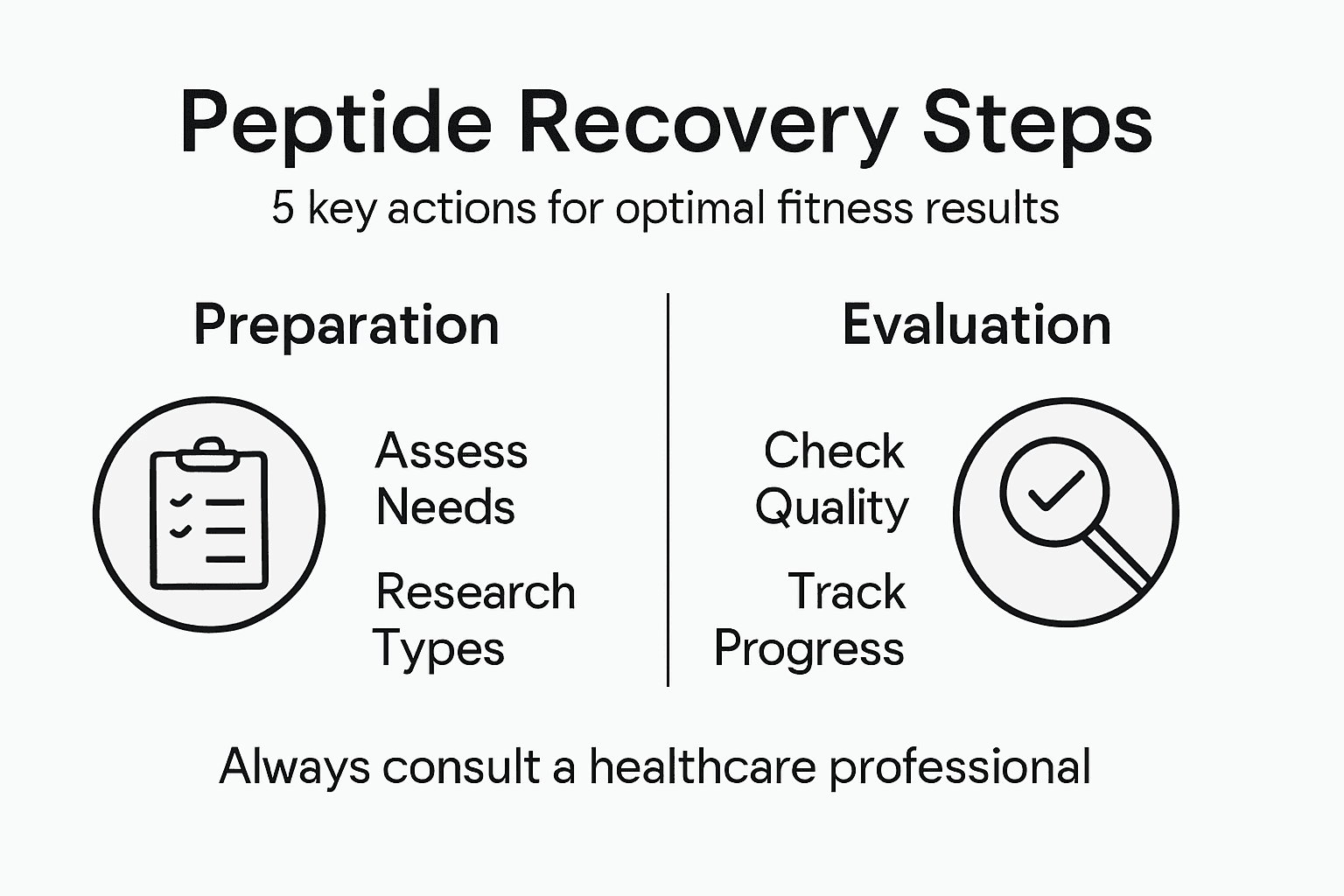
- Step 1: Assess Your Personal Recovery Needs
- Step 2: Research Peptide Types And Intended Effects
- Step 3: Consult Reputable Sources And Regulations
- Step 4: Evaluate Product Quality And Authenticity
- Step 5: Monitor Results And Adjust Selection
Quick Summary
| Key Insight | Explanation |
|---|---|
| 1. Assess Your Unique Recovery Needs | Tailor your recovery strategy by evaluating training intensity, muscle damage, and physiological baseline factors. |
| 2. Understand Peptide Types | Research various peptide categories to align their functions with your specific fitness goals for optimal results. |
| 3. Verify Product Quality | Ensure peptide authenticity by checking manufacturer reputation, third-party testing, and purity documentation. |
| 4. Monitor Performance Regularly | Continuously track key indicators like muscle growth and recovery speed to adjust your peptide selection effectively. |
| 5. Consult Trusted Sources | Rely on credible academic and regulatory sources to gather reliable information on peptides for safe supplementation. |
Step 1: Assess your personal recovery needs
Understanding your unique peptide recovery requirements is crucial for optimizing fitness performance. Your recovery strategy isn’t a one-size-fits-all solution but a personalised approach that depends on multiple physiological factors.
To effectively assess your recovery needs, start by examining your exercise profile through several key dimensions. Individual recovery parameters vary based on several critical factors:
- Training intensity – Evaluate your workout volume and stress levels
- Muscle damage extent – Assess micro-tears and tissue breakdown post-exercise
- Physiological baseline – Consider your age, sex, and current health status
- Recovery frequency – Determine time between training sessions
Your personal recovery assessment should involve tracking specific metrics like muscle soreness, energy levels, sleep quality, and performance consistency. Exercise and athletic performance research indicates that recovery needs fluctuate based on individual biological responses.
Your body provides unique signals – learning to interpret them is the first step towards optimised recovery.
Pro Tip: Keep a detailed training and recovery journal to identify your body’s specific peptide and nutritional recovery patterns.
Step 2: Research peptide types and intended effects
Identifying the right peptides for your fitness goals requires a systematic approach to understanding their diverse functionalities and targeted outcomes. Your research journey will involve exploring the complex world of peptide classifications and their specific physiological impacts.
Muscle-building peptide categories offer a comprehensive framework for selecting the most appropriate compounds. These peptides generally fall into several key groups:
- Growth Hormone Releasing Hormones (GHRHs) – Stimulate natural growth hormone production
- Growth Hormone Releasing Peptides (GHRPs) – Enhance muscle development and recovery
- IGF-1 Analogs – Support cellular growth and metabolic functions
- Selective Tissue Growth Modulators – Target specific physiological pathways
Each peptide type operates through unique mechanisms, influencing muscle growth, recovery speed, fat metabolism, and overall performance potential. Understanding these nuanced differences allows you to strategically align peptide selection with your specific fitness objectives.

Here’s a concise summary of key peptide categories and their primary impacts:
| Peptide Category | Main Function | Ideal Use Case |
|---|---|---|
| Growth Hormone Releasing Hormones (GHRHs) | Boosts natural growth hormone levels | Accelerated muscle growth |
| Growth Hormone Releasing Peptides (GHRPs) | Improves repair and recovery | Fast post-exercise recovery |
| IGF-1 Analogs | Promotes cell growth and repair | Enhanced lean muscle development |
| Selective Tissue Growth Modulators | Targets specific body tissues | Localised muscle improvement |
Research is not just about finding peptides, but understanding their precise biological interactions and potential outcomes.
Pro Tip: Cross-reference multiple scientific sources and consult with healthcare professionals to validate the potential effectiveness and safety of specific peptide types for your individual needs.
Step 3: Consult reputable sources and regulations
Navigating the complex landscape of peptide research requires a strategic approach to sourcing information and understanding legal frameworks. Your goal is to gather accurate, scientifically validated information while ensuring compliance with relevant regulations and ethical guidelines.
Anti-doping regulations for peptides provide critical guidance for athletes and fitness enthusiasts considering peptide supplementation. When researching potential peptide options, focus on credible sources that offer comprehensive insights:
- Academic journals – Peer-reviewed scientific publications
- Professional sports organizations – Official regulatory guidelines
- Medical research institutions – Comprehensive scientific databases
- Regulatory bodies – Official health and sports compliance documentation
Careful investigation involves distinguishing between research data and promotional material. Professional athletes, in particular, must pay close attention to prohibited substance lists and potential competitive implications of peptide usage.
Credible information is your most powerful tool in making informed decisions about peptide supplementation.
Pro Tip: Maintain a digital or physical folder of authoritative sources, including direct links to official regulatory documents, to ensure you always have accurate reference materials at your fingertips.
Step 4: Evaluate product quality and authenticity
Ensuring the integrity of peptide products requires a meticulous approach to verification and quality assessment. Your health and fitness goals depend on selecting peptides that meet rigorous scientific and safety standards.
Peptide safety and responsible sourcing demand careful examination of product credentials. When evaluating peptide quality, focus on these critical verification strategies:
- Manufacturing credentials – Verify manufacturer’s scientific reputation
- Third-party testing – Look for independent laboratory certifications
- Purity documentation – Request and review detailed composition reports
- Transparent sourcing – Investigate product origin and production methods
The authentication process involves multiple verification steps, including reviewing scientific documentation, checking laboratory certificates, and understanding the precise manufacturing protocols. Professional athletes and fitness enthusiasts must be especially vigilant about product legitimacy to avoid potential health risks or regulatory complications.
Not all peptides are created equal – your due diligence determines product reliability.
Pro Tip: Create a standardised checklist of quality verification criteria that you consistently apply to every potential peptide product before considering its use.
Step 5: Monitor results and adjust selection
Successful peptide selection is an ongoing process that requires consistent tracking, evaluation, and strategic modifications. Your approach should be dynamic, allowing for precise adjustments based on your body’s unique response and fitness progression.
Peptide therapy performance tracking demands a comprehensive monitoring strategy. Key performance indicators to assess include:
Use this reference guide to monitor peptide therapy progress:
| Indicator | Measurement Method | Expected Improvement |
|---|---|---|
| Muscle Mass | Tape measure, body scan | Visible muscle definition |
| Recovery Time | Duration tracking | Reduced soreness duration |
| Energy/Stamina | Workout log | Longer, more intense sessions |
| Metabolic Markers | Blood tests, body composition | Improved fat-to-muscle ratio |
- Muscle growth rates – Measure changes in muscle mass and definition
- Recovery speed – Track time needed between intense training sessions
- Energy levels – Monitor overall stamina and workout intensity
- Physiological markers – Note changes in body composition and metabolism
Professional athletes understand that peptide selection is not a static process. The science of recovery emphasises the importance of continual assessment, recommending periodic consultations with healthcare professionals to refine your peptide protocol.
Effective peptide therapy is a journey of constant adaptation and personalised optimization.
Pro Tip: Maintain a detailed log documenting your physiological responses, training performance, and any side effects to create a comprehensive reference for future peptide adjustments.
Unlock Your Best Recovery with Trusted Peptide Solutions
Selecting the right recovery peptides to enhance your fitness results can feel overwhelming when faced with questions about quality, safety and effectiveness. This article highlights key challenges such as evaluating peptide types, assessing personal recovery needs and monitoring outcomes. If you want to move from research to action with confidence Northern Peptides provides carefully curated peptides, educational resources and transparent sourcing to support your optimal recovery journey.
Explore our Uncategorized – Northern peptides category for insightful guides and product information that align perfectly with your goals.

Take control of your recovery strategy today by visiting our main portal at Northern Peptides to access premium research peptides and expert educational content. Start now to ensure every workout counts and your progress is supported by trusted, high-quality solutions.
Frequently Asked Questions
How do I assess my personal recovery needs for peptides?
To assess your personal recovery needs, evaluate factors such as your training intensity, muscle damage, physiological baseline, and recovery frequency. Track metrics like muscle soreness, energy levels, and sleep quality over time to determine your unique recovery profile.
What types of peptides should I research for recovery and muscle growth?
Research different peptide categories such as Growth Hormone Releasing Hormones (GHRHs), Growth Hormone Releasing Peptides (GHRPs), IGF-1 Analogues, and Selective Tissue Growth Modulators. Understanding these groups can help you identify which peptides align best with your fitness goals and needs.
How can I ensure the quality and authenticity of peptide products?
Verify peptide product quality by checking the manufacturer’s credentials, seeking third-party testing certifications, and reviewing purity documentation. Create a checklist of these verification criteria to apply consistently when evaluating any new peptide product.
What indicators should I monitor to evaluate the effectiveness of selected peptides?
Monitor indicators like muscle mass, recovery time, energy levels, and physiological markers to evaluate the effectiveness of your peptides. Keep a detailed log of your progress to identify improvements and adjust your peptide selection as needed.
How often should I consult healthcare professionals about my peptide use?
It’s advisable to consult healthcare professionals periodically, especially after significant changes in your performance or recovery metrics. Aim for consultations every few months to refine your peptide protocol based on your body’s unique responses and your fitness progression.