

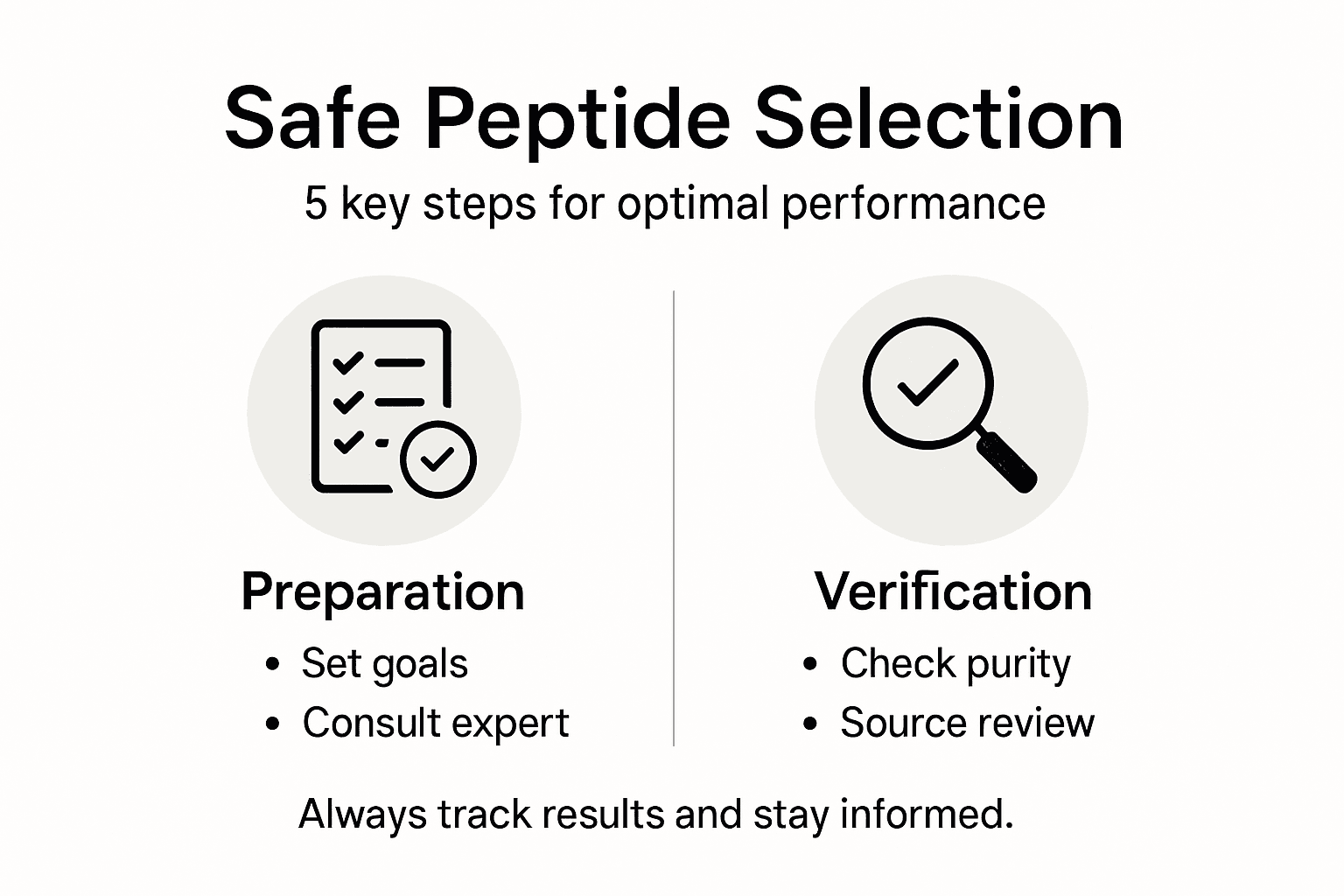
Selecting the right peptides for performance and recovery is rarely straightforward. Fitness enthusiasts and dedicated professionals know that every training routine, nutrition strategy, and individualised peptide protocol deserves careful alignment with personal goals and biological needs. By focusing on strategic self-assessment, ethical sourcing, rigorous authentication, thoughtful dosing, and detailed documentation, you set yourself up for safer and more effective results. This guide shares practical steps to refine your peptide strategy for peak performance with precision and confidence.
Table of Contents
- Step 1: Assess Personal Fitness Goals And Needs
- Step 2: Review Reliable Peptide Supply Sources
- Step 3: Verify Product Purity And Authenticity
- Step 4: Evaluate Dosage And Administration Protocols
- Step 5: Monitor And Document Results For Safety
Quick Summary
| Key Point | Explanation |
|---|---|
| 1. Assess fitness goals clearly | Understand your primary fitness goals to choose the right peptides tailored to your needs. |
| 2. Source from reliable suppliers | Select peptide suppliers prioritizing documented testing and transparency to ensure quality. |
| 3. Verify product authenticity | Conduct thorough checks, including certificates of analysis, to confirm peptide legitimacy. |
| 4. Personalize dosage strategies | Tailor peptide dosages to your individual metabolic rate and training goals for maximum efficiency. |
| 5. Document results thoroughly | Keep detailed records of your progress and experiences to inform future peptide use and safety. |
Step 1: Assess personal fitness goals and needs
Selecting the right peptides requires a strategic and personalized approach that aligns with your specific fitness objectives. Finding the right peptide options begins with a comprehensive self-assessment of your current physical condition and desired outcomes.
Start by conducting an honest evaluation of your fitness landscape. Ask yourself critical questions about your primary goals – whether you aim to build muscle mass, improve endurance performance, accelerate recovery time, or enhance overall body composition. Consider the following key areas for assessment:
- Current fitness level and baseline measurements
- Specific performance targets
- Any existing physical limitations or health considerations
- Time commitment available for training and recovery
Your peptide selection should act as a precision tool tailored to your unique physiological needs. Professional athletes and fitness enthusiasts understand that individualized peptide strategies can produce dramatically different results based on personal biochemistry and training objectives.
Successful peptide selection demands a nuanced understanding of your body’s specific requirements and performance goals.
Documenting your baseline measurements provides crucial context. Take detailed notes on current weight, muscle mass percentage, recovery rates, and any performance metrics relevant to your objectives. This data will help you track progress and make informed decisions about which peptide protocols might serve you best.
Pro tip: Consult with a sports medicine professional or peptide research specialist to validate your assessment and receive personalized guidance aligned with your specific fitness goals.
Here’s a quick summary of factors influencing peptide selection for fitness:
| Factor | Impact on Results | Professional Guidance Benefit |
|---|---|---|
| Personal goals | Directs peptide choice | Clarifies training priorities |
| Baseline evaluation | Sets realistic targets | Prevents inappropriate use |
| Time commitment | Shapes regimen intensity | Optimises progress tracking |
| Health considerations | Ensures safety | Reduces complication risks |
Step 2: Review reliable peptide supply sources
Navigating the complex landscape of peptide suppliers requires a methodical and cautious approach to ensure research integrity and product quality. Ethical sourcing practices are paramount when selecting a reliable peptide supplier for your performance enhancement goals.
When evaluating potential peptide sources, focus on several critical assessment criteria:
- Documented laboratory testing procedures
- Third-party quality verification
- Transparent research documentation
- Comprehensive batch analysis reports
- Compliance with regulatory standards
- Clear shipping and handling protocols
Scientific credibility matters more than marketing claims. Professional researchers understand that reputable suppliers demonstrate their commitment through rigorous quality control mechanisms. Your selection process should prioritize suppliers who provide comprehensive documentation about their peptide production standards.
Trustworthy peptide suppliers distinguish themselves through transparent scientific evidence and meticulous quality assurance protocols.
Carefully review each potential supplier’s credentials. Look for organisations that publish detailed chemical analysis reports, maintain strict laboratory standards, and can provide verifiable research documentation. Cross-reference supplier claims with independent scientific literature and professional recommendations to validate their legitimacy.

Pro tip: Request sample documentation and conduct preliminary small-scale testing before committing to a large peptide supply order to validate product quality and consistency.
Step 3: Verify product purity and authenticity
Ensuring the legitimacy and quality of peptide products requires a systematic approach to verification that goes beyond surface-level claims. Lab testing for peptide safety represents a critical step in protecting your research and performance objectives.
To comprehensively verify product authenticity, implement the following rigorous assessment strategies:
- Request detailed certificates of analysis
- Examine molecular weight specifications
- Validate amino acid sequence confirmation
- Check purity percentage documentation
- Review independent laboratory testing reports
- Assess storage and handling recommendations
Scientific validation demands more than trusting marketing materials. Professional researchers understand that quantitative verification methods are essential for determining peptide quality. Your authentication process should involve multiple layers of scientific scrutiny to eliminate potential contamination or misrepresentation.
Authentic peptide products are distinguished by transparent, verifiable scientific documentation that withstands rigorous professional examination.
Advanced authentication requires sophisticated analytical techniques. Mass spectrometry, high-performance liquid chromatography, and amino acid sequencing provide definitive insights into peptide composition and integrity. Always cross-reference supplier claims with independent scientific standards and seek comprehensive documentation that demonstrates precise molecular characterization.
Pro tip: Invest in multiple verification techniques and maintain detailed records of each peptide batch’s analytical results to establish a comprehensive quality control framework.
Compare core aspects of supplier credibility versus product authenticity checks:
| Assessment Focus | Supplier Credibility | Product Authenticity Validation |
|---|---|---|
| Evaluator | Organisation and lab credentials | Scientific analysis and testing |
| Core Documentation | Batch reports, regulatory proof | Certificates, purity records |
| Validation Method | Third-party audits | Analytical techniques used |
| Risk if ignored | Substandard sourcing | Ineffective or harmful products |
Step 4: Evaluate dosage and administration protocols
Determining the optimal peptide dosage requires a meticulous and personalised approach that considers multiple physiological factors. Clinical pharmacology guidelines provide critical insights into developing safe and effective peptide administration strategies.
When establishing your dosage protocol, consider these fundamental assessment criteria:
- Individual metabolic rate and body composition
- Specific performance enhancement objectives
- Existing health conditions
- Current fitness and training intensity
- Potential interaction with other supplements
- Recovery and adaptation periods
Precise dosage calculation demands more than generic recommendations. Professional athletes and researchers understand that personalised peptide protocols require comprehensive evaluation of individual physiological responses. Your administration strategy should incorporate systematic monitoring and incremental adjustments based on measurable biological markers.
Effective peptide dosing is a dynamic process that demands continuous assessment and nuanced understanding of individual biochemical responses.
Advanced peptide administration involves carefully structured protocols that minimise potential side effects while maximising performance outcomes. Start with conservative dosages, implement rigorous tracking mechanisms, and be prepared to modify your approach based on empirical evidence and physiological feedback.
Pro tip: Maintain a detailed log of your peptide administration, tracking both objective measurements and subjective experiences to develop a comprehensive understanding of your body’s unique response.
Step 5: Monitor and document results for safety
Safety tracking represents a critical component of responsible peptide research and performance enhancement. Comprehensive safety monitoring protocols are essential for understanding your body’s unique physiological response and minimising potential risks.
Implement a systematic documentation strategy that captures comprehensive insights about your peptide experience:
- Baseline physiological measurements
- Detailed daily symptom tracking
- Quantitative performance metrics
- Subjective experience notes
- Potential side effect observations
- Recovery and adaptation indicators
Rigorous documentation transcends casual record-keeping. Professional researchers understand that meticulous tracking provides invaluable data about individual peptide interactions. Your monitoring approach should integrate objective measurements with nuanced personal observations to create a holistic understanding of your physiological response.
Comprehensive safety documentation transforms individual research into a structured, scientifically meaningful exploration of peptide effects.
Advanced monitoring involves creating a multidimensional tracking system that captures physiological, psychological, and performance-related data. Develop a consistent recording methodology, use standardised assessment tools, and remain objectively curious about your body’s unique peptide response.
Pro tip: Create a digital tracking template with predefined categories to ensure consistent, comprehensive documentation throughout your peptide research journey.
Discover Safe and Effective Peptide Solutions for Your Performance Goals
Navigating the complexities of peptide selection to enhance your fitness performance requires reliable sources and trustworthy information. This expert guide highlights the importance of assessing your unique fitness objectives, verifying product purity, and tailoring precise dosage protocols. At Northern Peptides, we understand these challenges and offer a comprehensive range of research peptides backed by scientific integrity to support your journey.

Explore our carefully curated selection of peptides and benefit from detailed educational resources designed to empower your safe and effective performance enhancement. Begin your peptide research with confidence by visiting our Uncategorized – Northern Peptides page. Ready to take control of your peptide strategy today Learn more at Northern Peptides and make informed choices for your fitness success.
Frequently Asked Questions
How do I assess my personal fitness goals for peptide selection?
Assess your personal fitness goals by evaluating your current physical condition and desired outcomes, such as building muscle mass, improving endurance, or enhancing recovery time. Document your current fitness level and any health considerations to create a tailored peptide strategy.
What should I consider when reviewing peptide supply sources?
When reviewing peptide supply sources, focus on their laboratory testing procedures, quality verification processes, and transparent research documentation. Choose suppliers that can provide clear batch analysis reports and comply with regulatory standards for quality assurance.
How can I verify the purity and authenticity of peptide products?
Verify the purity and authenticity of peptide products by requesting detailed certificates of analysis and examining molecular weight specifications. Use independent laboratory testing reports to ensure that the product meets safety and quality standards.
What factors should I evaluate when determining optimal peptide dosages?
Evaluate factors such as your metabolic rate, performance enhancement objectives, existing health conditions, and training intensity when determining optimal peptide dosages. Start with conservative dosages and adjust them as you monitor your body’s response over time.
Why is monitoring and documenting results critical for peptide use?
Monitoring and documenting results is critical because it helps you understand your body’s unique physiological responses to peptides. Implement a detailed tracking system that captures baseline measurements, daily symptoms, and performance metrics to enhance safety and effectiveness in your regimen.